Healthcare Marketing

    The Key Benefits of Professional SEO for Healthcare Practices

    Organic search is the most cost-effective patient acquisition channel in healthcare — but only when it is done right. Here is what professional SEO really delivers, and when in-house effort is enough.

    Vigorant Healthcare Marketing TeamJune 202610 min read
    Healthcare practice owner reviewing organic search rankings and SEO analytics on a laptop
    • Published:June 24, 2026
    • Author:Vigorant Healthcare Marketing Team
    • Category:Healthcare Marketing · SEO Strategy · Organic Growth
    Why It Matters

    What Professional SEO Means for a Modern Practice

    For practices that have not yet tapped the power of organic search, there has never been a better time to start. Never before has it been so accessible for a local dental, medical, or chiropractic practice on a modest budget to win meaningful visibility in its market. Professional search engine optimization gives practices the flexibility to grow affordably in an age of digital connectivity — and it is exactly why organic search has become a new standard for sustainable patient acquisition.

    Professional SEO is the disciplined practice of improving where and how your website appears in search results and AI-generated answers. It blends three layers: technical health (site speed, mobile experience, crawlability, and structured data), content depth (condition-specific pages written to genuine medical and patient-care standards), and authority (reviews, citations, links, and trust signals that tell search engines your practice is credible).

    The distinction that matters most is between casual, occasional optimization and a sustained professional program. Anyone can edit a page title. Far fewer can architect a site that ranks competitively in a dense local market, earns trust for 'Your Money or Your Life' health topics, and converts that traffic into booked appointments. Choosing the right partner is the single biggest factor in getting real value from SEO.


    "SEO is about helping search engines understand and present content. Your site might be smaller or larger than our example site and offer vastly different content, but the optimization topics we discuss apply to sites of all sizes and types."

    Search analytics dashboard showing organic traffic growth for a healthcare website
    The Upside

    The Key Benefits of Professional SEO

    Where expert, sustained search optimization delivers durable value that practices cannot easily replicate alone.

    01

    A More User-Friendly Website

    Good SEO and good user experience move together. Professional optimization improves page speed, mobile usability, clear navigation, and Core Web Vitals — the same factors that help a nervous patient quickly find your services, hours, and booking link. A faster, clearer site ranks better and keeps more visitors from bouncing.

    02

    Lower Long-Term Cost Per Patient

    Unlike paid ads, which stop delivering the moment you pause spending, organic rankings compound. As authority builds, a well-optimized page can attract qualified patients month after month at a steadily declining effective cost per acquisition — making SEO one of the most affordable acquisition channels available to a practice.

    03

    Stronger Local & 'Near Me' Visibility

    Most healthcare searches are local and increasingly mobile. Professional local SEO optimizes your Google Business Profile, citations, reviews, and location pages so your practice appears in the map pack and 'near me' results — exactly where high-intent patients choose a provider close to home.

    04

    Better Conversion Rates

    Quality SEO does not just bring traffic; it brings the right traffic. By aligning content with what patients actually search and removing friction on the path to booking, professional optimization improves the likelihood that a visit becomes a phone call, form fill, or scheduled appointment.

    05

    Greater Brand Awareness & Trust

    Ranking consistently for the conditions you treat builds familiarity and credibility long before a patient calls. Repeated visibility in trusted positions — backed by accurate, expert content — increases brand awareness and improves customer introductions and retention across your service area.

    Marketing team reviewing organic search performance charts on a large display
    Key Insight

    "In healthcare, the practices that win organic search are rarely the ones with the biggest budget — they are the ones whose visibility, content, and trust signals are managed with real expertise and consistency."

    The Limits

    The Limits of DIY and In-House SEO

    Where a do-it-yourself or untrained in-house approach falls short — and the business, compliance, and ranking risks practice owners should understand.

    Practice manager working alone on website updates with multiple browser tabs open

    It Consumes Time You Do Not Have

    SEO is not a one-time task; it is an ongoing discipline of research, content production, technical maintenance, and analysis. For a busy practice, the hours required to do it well compete directly with patient care and operations. Most DIY efforts stall after the initial burst because the work never truly ends — and inconsistency is one of the fastest ways to lose hard-won rankings.

    Shallow Keyword & Content Architecture

    Editing a page title is easy; building the structure that actually ranks is not. Competitive healthcare SEO depends on a deliberate architecture that most generalists never implement.
    Condition-specific landing pagesKeyword-driven URL silosLocal service-area pagesInternal linking architectureSchema.org structured dataE-E-A-T author signals

    Compliance and Privacy Blind Spots

    SEO for healthcare frequently touches forms, reviews, intake widgets, and patient stories — all areas where privacy rules apply. An untrained approach can inadvertently expose protected health information or add data-collection elements without proper safeguards, creating risk that a specialist would catch.
    • Never publish protected health information without documented patient consent
    • Use HIPAA-aware, encrypted handling for any forms or intake widgets
    • Vet third-party SEO and analytics tools that touch patient data
    • Keep privacy policy and review-response practices accurate and compliant

    Risk of Outdated or Harmful Tactics

    Search guidelines evolve constantly, and the internet is full of obsolete advice. Well-meaning DIY efforts often rely on tactics that no longer work — or that actively harm a site, such as keyword stuffing, low-quality link buying, or thin AI-generated pages. Recovering from a self-inflicted penalty or quality issue is far more expensive than doing it right the first time.

    Weak E-E-A-T for Medical Topics

    Google classifies health content as 'Your Money or Your Life,' applying a higher quality bar. Content that lacks named clinical authorship, accurate medical detail, and credible corroboration struggles to rank for high-intent terms.

    "For pages about topics that could impact a person's health, financial stability, or safety, we have very high Page Quality rating standards, because low quality pages could potentially harm people."

    Google Search Quality Rater Guidelines

    No Reliable Measurement or Strategy

    Without proper analytics, call tracking, and conversion attribution, DIY SEO becomes guesswork. Practices end up unable to tell which efforts produce patients and which waste time. Professional programs are built around measurement — connecting rankings and traffic to real outcomes like calls, form fills, and booked appointments — so every decision is informed.
    Head-to-Head

    DIY / In-House SEO vs. Professional SEO: The Complete Comparison

    How a do-it-yourself or untrained in-house approach compares to a professional healthcare SEO program across the factors that drive real patient acquisition.

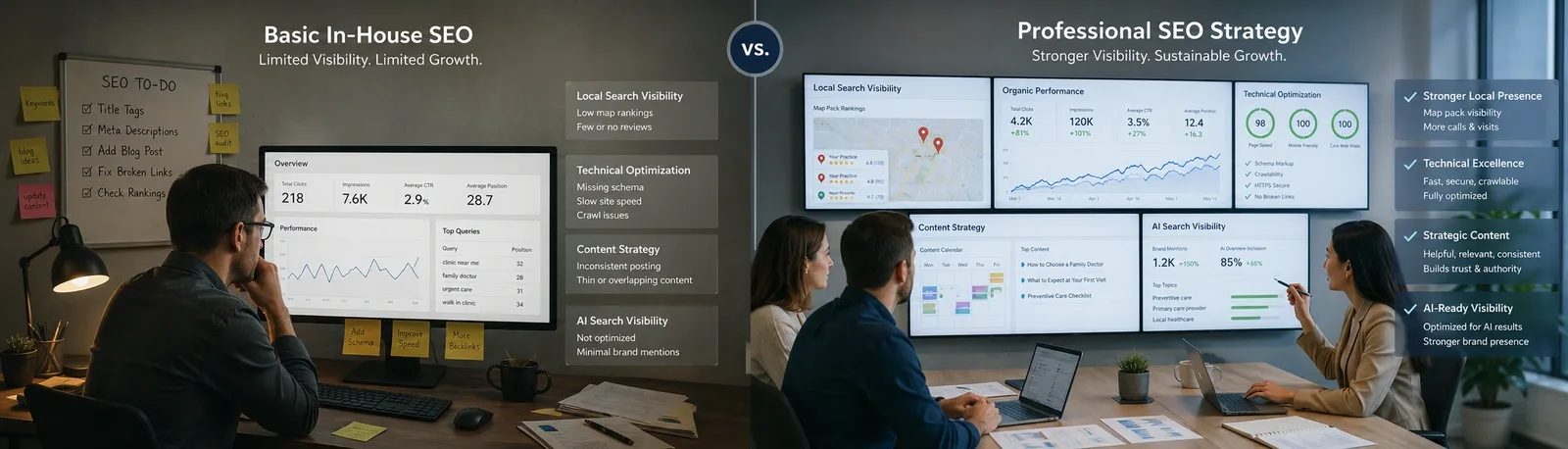
    CriteriaDIY / In-House SEOProfessional Healthcare SEO
    Speed to Get StartedImmediate — small edits todayOnboarding and audit first
    Upfront CostLow — mostly your timeMonthly investment / retainer
    Long-Term Cost Per PatientOften high — inconsistent resultsLower as authority compounds
    Technical SEO DepthLimited by skill and toolsEngineered: speed, schema, crawl
    Keyword & Content StrategyAd hoc, surface-levelResearched, condition-specific
    Local SEO & Map PackBasic profile managementFull local optimization program
    E-E-A-T for Health TopicsHard to meet YMYL barBuilt for medical authority
    Compliance AwarenessPrivacy blind spots likelyHIPAA-aware practices
    Measurement & ReportingLimited; mostly guessworkCall tracking & attribution
    AI Search (GEO/AEO) VisibilityRarely addressedOptimized for AI answers
    Consistency Over TimeStalls when staff get busySustained, accountable cadence
    Best ForBasics & maintenance tasksPractices serious about growth

    Handling SEO basics in-house — accurate listings, reviews, simple updates — is genuinely useful. But for practices with real growth ambitions in competitive markets, a professional, sustained SEO program consistently outperforms DIY across the dimensions that drive patient acquisition.

    Decision Guide

    When DIY SEO Is Enough — and When You Need Expert Help

    ✓ DIY / In-House SEO Makes Sense For:

    • Keeping your Google Business Profile accurate, complete, and up to date
    • Requesting and responding to patient reviews on an ongoing basis
    • Making small content edits, fixing typos, and updating hours or services
    • A brand-new practice covering the basics while planning a larger investment

    ⚠ Professional SEO Is Worth It When:

    • You compete in a dense local market where ranking depth determines new patients
    • Your website is a primary new-patient acquisition channel for the practice
    • You are a multi-location group or growing network needing scalable architecture
    • You need to rank for medical topics that demand strong E-E-A-T and trust signals
    • You want measurable accountability tying rankings to real calls and bookings
    Vigorant's Approach

    How Vigorant Builds Healthcare SEO That Drives Patient Growth

    Vigorant's approach to professional SEO is built on a principle that casual or generalist optimization cannot replicate: deep healthcare domain expertise combined with a rigorous, measurable process engineered specifically for dental, medical, and chiropractic practices.

    • Technical SEO foundation — site speed, mobile experience, crawlability, and Core Web Vitals

    • Condition-specific content written to meet E-E-A-T standards for medical topics

    • Local SEO program covering Google Business Profile, citations, reviews, and service-area pages

    • Full Schema.org structured data for healthcare entities, FAQ, and breadcrumb markup

    • HIPAA-aware handling of any forms, intake, or patient-facing data elements

    • AEO and GEO optimization so your practice surfaces in AI answers on ChatGPT, Gemini, Claude, and Perplexity

    Healthcare marketing team reviewing an SEO strategy and keyword plan for a dental practice
    AI Search Visibility

    The GEO / AIO Factor: Is Your Practice Visible in AI Search?

    Modern SEO no longer ends at the classic blue links. Generative Engine Optimization (GEO) — structuring content so AI-powered search engines surface your practice in generated answers — is now a core part of professional SEO. When a prospective patient asks ChatGPT, Google Gemini, Perplexity, or Microsoft Copilot 'Who is a good dentist in [city]?', the AI assembles its answer from content it has indexed and judged authoritative. Practices optimized for this are increasingly the ones that get named.

    ChatGPTGoogle GeminiPerplexityMicrosoft CopilotClaude

    Clearly structured FAQ content with specific, authoritative answers

    Named clinical authors with verified credential information

    Schema.org markup identifying content type, publisher, and subject

    External citations from credible, institutional sources

    High domain authority built through consistent expert-level content

    DIY SEO rarely touches GEO at all. Optimizing for AI-generated answers is an advanced content and technical strategy that requires specialist implementation — and it is fast becoming a decisive competitive factor in healthcare markets.

    FAQ

    Frequently Asked Questions

    Everything healthcare practice owners need to know about professional SEO, DIY limits, local search, compliance, and choosing the right partner.

    Professional SEO improves the visibility of your practice in organic search and AI-generated answers so that more local patients find you when searching for the services you offer. It combines technical optimization, condition-specific content, local SEO, and trust signals to attract qualified, ready-to-book patients over time — a durable, compounding channel rather than a paid placement that disappears when the budget stops.

    Ready to Grow?

    Organic Search Is the Most Affordable Way to Grow — When It Is Done Right.

    If your dental, medical, or chiropractic practice is ready to turn organic search into a steady, compounding source of new patients — built for trust, visibility, and conversion — Vigorant is ready to help.

    • HIPAA-Aware Practices
    • Healthcare-Exclusive Agency
    • Measurable, Ethical SEO