Healthcare Marketing

    Social Media Marketing for Startups: Benefits, Risks & the Tips That Actually Work

    Social media can be a startup's secret weapon for brand awareness and leads — or a time sink that goes nowhere. The difference is strategy, consistency, and knowing when to bring in expert help.

    Vigorant Healthcare Marketing TeamUpdated June 202610 min read
    Startup founder planning a social media content calendar on a laptop and phone
    • Published:October 13, 2022 · Updated June 24, 2026
    • Author:Vigorant Healthcare Marketing Team
    • Category:Healthcare Marketing · Social Media · Startups
    Why It Matters

    Why Social Media Is a Startup's Most Accessible Growth Channel

    Convincing people to choose you is hard, even when you have built a genuinely great product or service. Lead generation and website traffic remain among the top challenges new businesses report — and for early-stage practices with thin budgets, the channels that scale on time rather than dollars matter most. Social media is exactly that kind of channel.

    Nearly every startup creates social profiles, yet many fail to move the audience. The reason is rarely effort and almost always strategy. Posting without a plan, jumping between platforms, and going quiet for weeks all blunt the return. A sound, consistent social media strategy does the opposite: it improves brand awareness, generates leads, and lowers the cost of acquiring each new customer.

    The stakes are real. Surveys consistently find that a strong social media service experience makes customers far more likely to recommend a brand to others — word-of-mouth that compounds at no extra cost. The question for most founders, then, is not whether to use social media, but how to do it well, and when running it alone stops being the smartest use of their time.

    "A majority of U.S. adults use social media, making it one of the broadest and most accessible channels available to a new business."

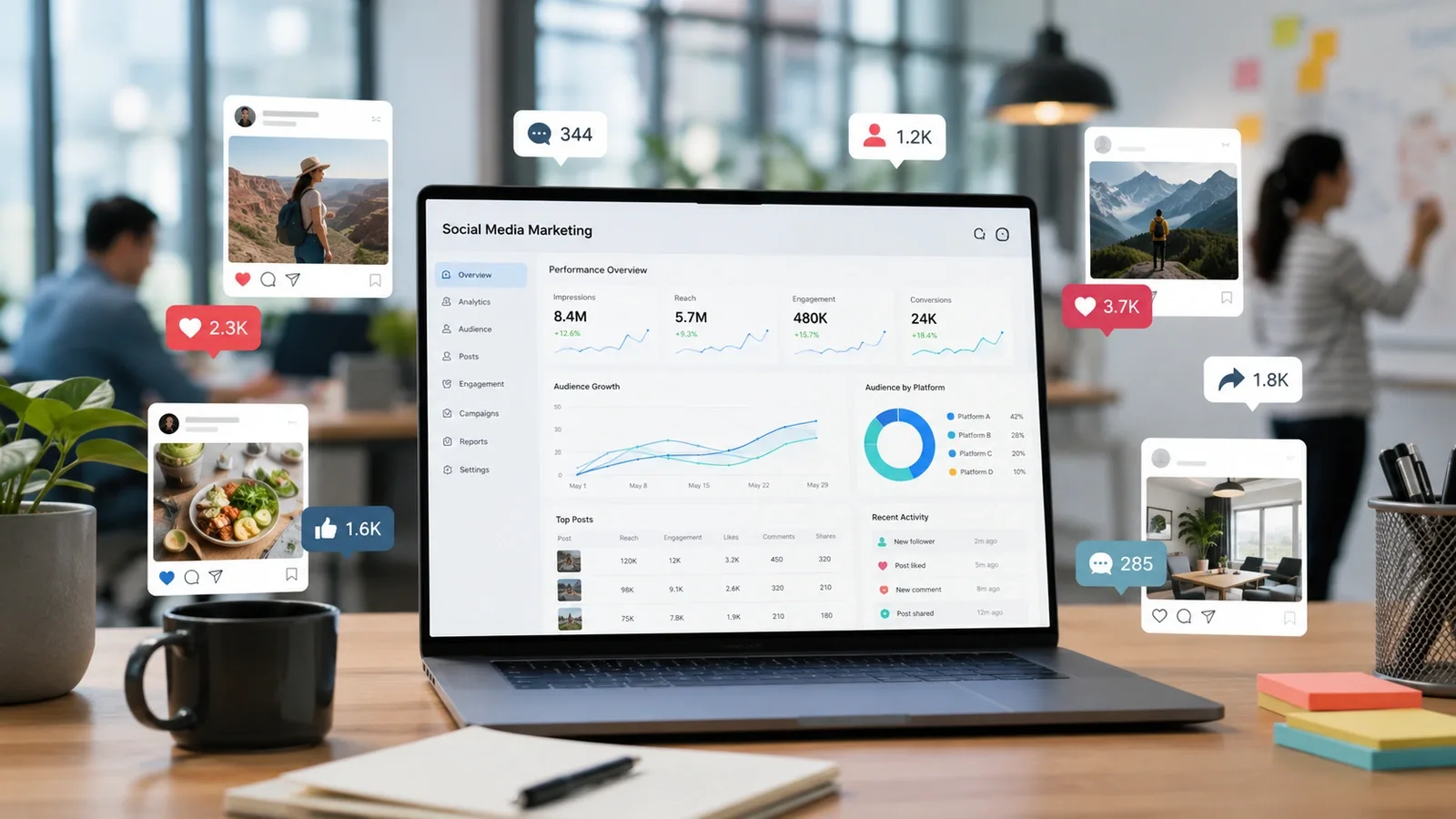
    Social media engagement metrics and audience growth shown on a screen
    The Upside

    The Benefits of Social Media Marketing for Startups

    Where social media genuinely earns its place in a lean startup marketing budget — especially in the earliest stages of building demand.

    01

    Improves Brand Awareness Fast

    Social media is one of the most efficient ways to put a new brand in front of people. A consistent presence steadily increases visibility and recognition, and the work compounds: each post, share, and comment widens your reach. For a startup, a few focused hours each week can build a meaningful competitive edge over quieter rivals.

    02

    Productive and Cost-Effective

    Creating profiles costs nothing, and organic reach can deliver real exposure before you spend a dollar on ads. Because digital consumers spend hours on social platforms every day, the audience is already there. For startups with limited budgets and no room for expensive media buys, that economics is hard to beat.

    03

    Drives Website Traffic and Leads

    Every post is a reason for a follower to click through to your site. The higher the quality and relevance of your content, the more inbound traffic and qualified leads you earn. Over time, social becomes a dependable top-of-funnel source that feeds your booking pages, forms, and email list.

    04

    Builds Direct Relationships and Feedback

    Social media lets you talk with customers directly — answering questions, gathering feedback on a new service, and learning what your audience actually wants. Many people research a brand's social presence before exploring other options, so responsive, helpful interaction quietly shapes their first impression of you.

    05

    Supports SEO and Reputation

    Sharing your owned content on social platforms amplifies its reach and can support your broader search visibility. Just as importantly, satisfied followers begin saying good things about your brand and recommending you to others — building the kind of organic reputation that no ad budget can buy outright.

    Startup team collaborating on a social media marketing strategy in an open office
    Key Insight

    "Social media for your startup can be a secret weapon to create more leads and increase brand awareness — but only when strategy and consistency replace random posting."

    The Risks

    The Hidden Challenges of Doing Startup Social Media Alone

    Where a do-it-yourself, no-strategy approach quietly drains time and budget — and why so many early-stage social efforts stall before they pay off.

    Founder reviewing underperforming social media analytics and metrics

    Posting Without a Strategy

    The most common failure is activity without direction. Many startups have profiles on every network but no clear goals, audience definition, or content plan tying it together. Without a sound strategy, posts get random reach, messaging drifts, and the channel never compounds — leaving founders to conclude, wrongly, that 'social media doesn't work for us.'
    No content calendarUnclear goalsInconsistent messaging

    Spreading Too Thin Across Platforms

    Trying to be everywhere at once is a classic startup trap. Each platform has its own format, audience, and rhythm, and maintaining all of them with a small team usually means doing all of them poorly. It is far more effective to identify the one or two channels that fit your niche and run focused campaigns there than to dilute effort across five.
    Channel overloadDiluted effortFormat mismatch

    The Real Cost Is Your Time

    Social media looks free, but for a founder it is rarely cheap. Planning content, designing graphics, writing captions, replying to comments, and tracking results add up to many hours a week — hours pulled directly from running the business. Underestimating this time cost is why DIY social so often gets deprioritized the moment things get busy.
    Hidden time costFounder bandwidthDeprioritized when busy

    Ignoring Analytics and Mobile Users

    Without tracking the right metrics, you cannot tell which posts drive inquiries and which simply fill the feed — so you keep guessing. Many startups also overlook that the majority of social usage happens on mobile, publishing content that looks broken on a phone. Both gaps quietly cap performance and waste the effort already spent.
    No data reviewMobile neglectGuesswork decisions

    Inconsistency and Going Quiet

    Staying active is what keeps an audience aware that you exist; long silences erase momentum and signal a brand that may not be around. Enthusiastic, regular participation is a genuine competitive advantage — yet it is the first thing to slip when a small team is stretched. Inconsistency, more than any single bad post, is what stalls early social growth.
    Lost momentumAudience drop-offStretched team

    "Staying active on social media helps you in the long run and lets your audience know you exist — participate enthusiastically to gain your competitive advantage."

    Vigorant Healthcare Marketing Team

    Compliance Blind Spots for Healthcare Startups

    For startups in regulated fields like healthcare, social media adds risk that general advice ignores. Sharing patient images or stories without proper consent, discussing protected health information, or making unsupported claims can create real legal and reputational exposure. Compliant social requires consent workflows, private channels for patient questions, and careful claim language — safeguards a DIY approach often misses entirely.
    Consent gapsPHI exposure riskUnsupported claims
    Head-to-Head

    DIY In-House vs. Specialist Social Media Marketing

    How running social media yourself compares to partnering with a specialist team, across the criteria that decide whether a startup's social efforts actually grow demand.

    CriteriaDIY In-House SocialSpecialist Social Partner
    Time to LaunchImmediate — you start todayShort onboarding, then managed
    Upfront CostLow — mostly your timeMonthly retainer or project fee
    Strategy DepthOften ad hocGoal-driven, documented plan
    Founder Time RequiredHigh — many hours weeklyLow — handled for you
    Content QualityVariable, DIY graphicsProfessional, on-brand
    Platform FocusRisk of spreading thinPrioritized by data
    Analytics & ReportingInconsistent trackingStructured, regular reporting
    Paid AmplificationTrial and errorManaged, optimized spend
    Healthcare ComplianceEasy to overlookConsent & HIPAA-aware workflow
    ConsistencySlips when busyMaintained by the team
    Best ForEarliest validation stagePractices ready to scale demand

    Doing social media yourself is a reasonable way to validate the channel in the earliest days. For startups and practices ready to turn social into a dependable source of leads, a specialist team consistently wins on strategy, consistency, and the compliance details that matter most in healthcare.

    Decision Guide

    When to Run Social Yourself — and When to Bring In Experts

    ✓ DIY In-House Social Makes Sense When:

    • You are at the earliest stage, validating whether social media moves the needle for your audience
    • You have time to post consistently and genuinely enjoy interacting with your community
    • Your messaging is simple and does not yet involve regulated claims or patient data
    • You are running a single focused channel and testing one or two content formats
    • Budget is the hard constraint and your own hours are the most available resource

    ⚠ Expert Help Is Worth It When:

    • Social media is becoming a primary lead and patient-acquisition channel you cannot afford to neglect
    • Founder time is now too valuable to spend on graphics, captions, and daily community management
    • You are competing in a crowded local market where consistency and quality decide who wins attention
    • Paid amplification is on the table and you need it optimized rather than guessed at
    • You operate in healthcare, where consent, HIPAA-awareness, and careful claims must be built in
    Vigorant's Approach

    How Vigorant Turns Social Media Into Real Patient Demand

    Vigorant builds social media programs specifically for healthcare practices and growth-stage startups — pairing a documented strategy with consistent, on-brand execution so your channels actually generate awareness, trust, and leads instead of just activity.

    • A documented strategy with clear goals, audience definition, and a maintained content calendar

    • Channel selection driven by data — concentrating effort where your audience actually engages

    • Professional, on-brand content and creative built for mobile-first feeds

    • Community management with HIPAA-aware consent workflows and private routing for patient questions

    • Managed paid amplification to extend the reach of your best-performing content

    • Structured analytics and regular reporting so every decision is informed, not guessed

    Marketing team reviewing social media campaign performance dashboards
    AI Search Visibility

    Social Media and AI Search: Why Your Startup's Presence Now Feeds the Answer Engines

    Social media no longer lives in isolation. When a prospective customer asks ChatGPT, Google Gemini, Claude, Perplexity, or Microsoft Copilot to recommend a provider or compare options, these AI engines assemble answers from the public signals they can find — including your website, reviews, and the consistency and authority of your social presence. A startup with active, credible, well-structured social profiles gives these systems more to cite; an inconsistent or empty presence gives them nothing. Generative Engine Optimization (GEO) is the practice of shaping that footprint deliberately.

    ChatGPTGoogle GeminiPerplexityMicrosoft CopilotClaude

    A consistent brand name, profile details, and links across every social channel

    Clear, authoritative content that answers the questions your audience actually asks

    Active, recent engagement that signals you are a real, established business

    Reviews and social proof that AI engines can read as trust signals

    Owned content on your site that your social posts reinforce and link back to

    A random posting habit does nothing for AI visibility. A deliberate, consistent social strategy — connected to a strong website — increasingly determines whether AI answer engines mention your practice at all.

    FAQ

    Frequently Asked Questions

    Everything startup founders and new practice owners ask about social media marketing — from budgets and platforms to compliance and timelines.

    Social media is one of the most cost-effective ways for a startup to build brand awareness, reach a broad audience, and create direct relationships with potential customers. For new practices with limited budgets, it offers an accessible channel to demonstrate expertise, gather feedback, and earn trust before prospective patients ever make contact.

    Ready to Grow?

    Random Posting Is Not a Strategy — Let's Build One That Works.

    If your startup or practice is ready to turn social media into a dependable source of awareness, trust, and leads — without losing your week to it — Vigorant is ready to help.

    • HIPAA-Aware Workflows
    • Healthcare-Exclusive Agency
    • Strategy-First Social