Email marketing remains one of the highest-ROI channels available to any business. But in a world of overloaded inboxes, maximizing conversions requires more than sending emails — it demands strategy, segmentation, and smart automation.

Email marketing continues to deliver one of the strongest returns of any digital marketing channel. With an average ROI of $36 for every $1 spent, it remains a cost-effective, direct, and measurable way to engage customers and drive revenue. Yet most businesses leave significant conversion potential untapped by relying on generic campaigns rather than strategic, data-driven approaches.
The gap between average and exceptional email marketing performance comes down to a handful of disciplines: clean list management, precise audience segmentation, compelling copy, optimised CTAs, mobile-first design, and intelligent automation. When these elements work together — and when email strategy is aligned with your broader SEO goals — the results compound quickly.
"Email marketing, when executed with audience segmentation and behavioural triggers, consistently outperforms other digital channels in direct conversion metrics. The combination of personalisation and automation is the defining factor separating high-performing campaigns from average ones."
— Mailchimp Email Marketing Benchmarks & Statistics


Each of these strategies is in active use by high-performing marketing teams across industries today.
Poor email list hygiene is one of the most overlooked causes of low conversion rates. Invalid email addresses, inactive subscribers, and spam traps reduce your deliverability score, meaning fewer of your emails reach the inbox in the first place. Regularly auditing and cleaning your list — removing invalid addresses, re-engaging dormant subscribers, and using double opt-in for new sign-ups — ensures your campaigns reach real, engaged people who are genuinely interested in your offer.
A clean list of 5,000 engaged subscribers will consistently outperform a bloated list of 50,000 unverified contacts in both open rates and conversion rates.


Your subject line is the single most important factor in whether your email gets opened or deleted. Effective subject lines are concise — ideally 30 to 50 characters for full mobile visibility — action-oriented, and directly relevant to the recipient. Avoid vague teaser language that feels like clickbait, which damages trust and increases spam complaints. Instead, use clear, benefit-driven language that tells the reader exactly what they will gain by opening. A/B testing subject lines across every campaign is the fastest way to learn what resonates with your specific audience.
A compelling email with a weak or unclear call-to-action is a missed conversion opportunity. Your CTA button should be visually prominent, placed in clear white space, and use specific action language that matches the email's purpose. An email promoting an eBook download should say 'Download Your Free Guide' — not 'Click Here' or 'Learn More'. Consistency between your CTA language and the landing page it leads to is equally critical: mismatched messaging creates friction and increases bounce rates, reducing the conversion value of every click you earn.
Emails with a single, focused CTA consistently outperform emails with multiple competing calls-to-action.


Targeted email list segmentation is one of the highest-impact levers available to any email marketer. When subscribers receive content that is directly relevant to their interests, location, purchase history, or stage in the buyer journey, engagement and conversion rates rise significantly. Common segmentation criteria include geographic location, age and demographic data, past purchase behaviour, email engagement history, and position in the sales funnel. The more precisely you can match content to audience, the more likely each email is to drive the action you want.
Approximately half of all emails are opened on mobile devices. An email that renders poorly on a smartphone — with text too small to read, images that do not scale, or CTA buttons too small to tap — will lose conversions regardless of how strong the content is. Mobile-first email design means concise copy broken into short paragraphs, single-column layouts, images optimised for small screens, and large tappable CTA buttons. Subject lines should also be kept under 50 characters to display fully on mobile lock screens.
Explore Vigorant's Web Design Service →

The most effective email campaigns do not lead with a sales pitch — they lead with value. Including snippets, teasers, or previews of genuinely useful content — a how-to guide, an industry insight, a product demonstration, or an exclusive offer — gives subscribers a reason to click through to your website. The format can be textual, visual, or a combination, depending on your audience's preferences. Businesses that consistently deliver value in their emails build the trust and engagement that converts subscribers into loyal customers over time.
Email marketing and SEO are independent channels, but they are most powerful when aligned. Use Google's Campaign URL Builder to tag every email link with UTM parameters, then track the resulting traffic and conversions in Google Analytics. This reveals exactly which email campaigns are driving website visits and revenue, enabling smarter budget and content decisions. Beyond tracking, email campaigns can amplify SEO by driving traffic to high-priority landing pages, increasing dwell time, and generating social shares of content — all of which send positive engagement signals to search engines.

Poor email list hygiene is one of the most overlooked causes of low conversion rates. Invalid email addresses, inactive subscribers, and spam traps reduce your deliverability score, meaning fewer of your emails reach the inbox in the first place. Regularly auditing and cleaning your list — removing invalid addresses, re-engaging dormant subscribers, and using double opt-in for new sign-ups — ensures your campaigns reach real, engaged people who are genuinely interested in your offer.
A clean list of 5,000 engaged subscribers will consistently outperform a bloated list of 50,000 unverified contacts in both open rates and conversion rates.

Your subject line is the single most important factor in whether your email gets opened or deleted. Effective subject lines are concise — ideally 30 to 50 characters for full mobile visibility — action-oriented, and directly relevant to the recipient. Avoid vague teaser language that feels like clickbait, which damages trust and increases spam complaints. Instead, use clear, benefit-driven language that tells the reader exactly what they will gain by opening. A/B testing subject lines across every campaign is the fastest way to learn what resonates with your specific audience.

A compelling email with a weak or unclear call-to-action is a missed conversion opportunity. Your CTA button should be visually prominent, placed in clear white space, and use specific action language that matches the email's purpose. An email promoting an eBook download should say 'Download Your Free Guide' — not 'Click Here' or 'Learn More'. Consistency between your CTA language and the landing page it leads to is equally critical: mismatched messaging creates friction and increases bounce rates, reducing the conversion value of every click you earn.
Emails with a single, focused CTA consistently outperform emails with multiple competing calls-to-action.

Targeted email list segmentation is one of the highest-impact levers available to any email marketer. When subscribers receive content that is directly relevant to their interests, location, purchase history, or stage in the buyer journey, engagement and conversion rates rise significantly. Common segmentation criteria include geographic location, age and demographic data, past purchase behaviour, email engagement history, and position in the sales funnel. The more precisely you can match content to audience, the more likely each email is to drive the action you want.

Approximately half of all emails are opened on mobile devices. An email that renders poorly on a smartphone — with text too small to read, images that do not scale, or CTA buttons too small to tap — will lose conversions regardless of how strong the content is. Mobile-first email design means concise copy broken into short paragraphs, single-column layouts, images optimised for small screens, and large tappable CTA buttons. Subject lines should also be kept under 50 characters to display fully on mobile lock screens.
Explore Vigorant's Web Design Service →
The most effective email campaigns do not lead with a sales pitch — they lead with value. Including snippets, teasers, or previews of genuinely useful content — a how-to guide, an industry insight, a product demonstration, or an exclusive offer — gives subscribers a reason to click through to your website. The format can be textual, visual, or a combination, depending on your audience's preferences. Businesses that consistently deliver value in their emails build the trust and engagement that converts subscribers into loyal customers over time.

Email marketing and SEO are independent channels, but they are most powerful when aligned. Use Google's Campaign URL Builder to tag every email link with UTM parameters, then track the resulting traffic and conversions in Google Analytics. This reveals exactly which email campaigns are driving website visits and revenue, enabling smarter budget and content decisions. Beyond tracking, email campaigns can amplify SEO by driving traffic to high-priority landing pages, increasing dwell time, and generating social shares of content — all of which send positive engagement signals to search engines.

"Segmented email campaigns generate significantly higher open rates and click-through rates than non-segmented campaigns. Relevance is the single most powerful driver of email marketing conversion performance."
For industry email marketing benchmarks and best practices, see the Mailchimp Email Marketing Benchmarks resource linked in the footer of this page.
See how applying proven email marketing best practices changes every dimension of campaign performance.
Hover or tap each card to flip
Broad, unsegmented batch sends
Behavioural, segmented, intent-matched
Generic, low open rates
A/B tested, action-oriented, personalised
Vague, buried, low click-through
Prominent, specific, landing-page aligned
Unvalidated, high bounce rates
Clean, verified, high deliverability
Desktop-only, poor rendering
Mobile-first, responsive, tappable CTAs
Promotional-only, low engagement
Value-led, educational, trust-building
Manual sends, missed triggers
Behaviour-triggered, always-on sequences
Email and SEO run in silos
UTM-tracked, landing page integrated
Lost revenue, no follow-up
Automated recovery with incentives
Open rate only, no attribution
Full-funnel conversion tracking
One-off sends, high churn
Drip sequences, loyalty-focused nurture
Strategy and automation do not replace the need for genuine audience understanding, compelling creative, and consistent value delivery. The businesses winning with email marketing in 2025 are combining data-driven segmentation with authentic, human-crafted messaging — and tracking every conversion back to its source.
Understanding these limits helps marketers and business owners set realistic expectations and invest in the right combination of tools and talent.
Email automation tools can schedule and trigger messages, but they cannot develop or maintain a distinctive, authentic brand voice. The tone, personality, and storytelling that make subscribers genuinely look forward to your emails require skilled human copywriters who understand your brand and your audience deeply.
Trust is built through consistent value delivery, honest communication, and authentic customer relationships — not through automated sequences alone. Subscribers who feel they are receiving genuinely helpful, human-crafted content are far more likely to convert and remain loyal than those who recognise they are inside a generic automation funnel.
Email marketing platforms do not automatically ensure compliance with CAN-SPAM, GDPR, CASL, or other applicable regulations. Maintaining compliant unsubscribe mechanisms, accurate sender information, and appropriate data handling practices requires ongoing human oversight and legal awareness — not just platform defaults.
Analytics dashboards tell you what happened — they do not tell you why, or what to do next. Deciding which segments to prioritise, how to reposition a campaign that is underperforming, or how to respond to a sudden drop in engagement requires strategic human judgment that no tool can replicate.
"The most effective email marketing programmes combine the efficiency of automation with the irreplaceable value of human creativity, strategic thinking, and genuine audience empathy."
In 2025 and beyond, a growing share of marketing research begins on AI interfaces — not just Google's standard results page. Business owners and marketers ask ChatGPT, Gemini, Perplexity, and Claude questions like 'What is the best email marketing strategy for small businesses?' Whether your content is cited in those answers depends entirely on its structural authority, depth, and relevance.
Directly answers the exact questions marketers and business owners ask AI assistants about email strategy
Verifiable credentials and organisational affiliations cited on content pages to establish E-E-A-T
FAQPage, BlogPosting, and Organization entities correctly implemented for AI crawler comprehension
Links to credible, non-commercial sources such as Mailchimp benchmarks, DMA reports, and industry research
A broad, consistent library of expert-level email marketing and digital strategy content across your domain
Fast-loading, mobile-first, error-free website that AI crawlers can index completely and accurately

Vigorant is a growth marketing agency that applies conversion-focused strategy across every dimension of your digital presence — website design, SEO, email marketing, and CRO — within a human-led approach built specifically around your business goals and your customers.
Custom website design engineered for conversion and SEO performance
Email marketing strategy with segmentation, automation, and full-funnel tracking
SEO-aligned content that drives organic traffic to high-converting landing pages
CTA and landing page optimisation to maximise every email click
Email automation setup including drip campaigns, abandoned cart, and transactional sequences
Analytics and reporting with clear attribution from email send to final conversion
Everything business owners and marketers need to know about email marketing conversion rates, segmentation, automation, and SEO alignment.
An email marketing conversion rate is the percentage of email recipients who completed a desired action — such as making a purchase, signing up for a service, or downloading a resource — after clicking through from your email. It is calculated by dividing the number of recipients who completed the action by the total number of emails delivered, then multiplying by 100. Tracking this metric helps you understand how effectively your email campaigns are driving real business outcomes.
A good email marketing conversion rate varies by industry, campaign type, and business goal. The average email marketing conversion rate is approximately 15.22%, but top-performing campaigns can exceed this significantly. Factors such as list quality, subject line effectiveness, audience segmentation, and the clarity of your CTA all influence where your rate lands. Benchmarking against your own historical performance is often more useful than comparing to broad industry averages.
To calculate your email marketing conversion rate, divide the number of recipients who completed the desired action by the total number of emails sent, then multiply by 100. For example, if you sent 5,000 emails and 700 recipients clicked through to your website and converted, your conversion rate is 14%. You can use Google's Campaign URL Builder to tag your email links and track conversions accurately in Google Analytics.
Email list segmentation improves conversions by ensuring the right message reaches the right audience at the right time. When subscribers receive content that is relevant to their interests, location, purchase history, or stage in the buyer journey, they are significantly more likely to engage and take action. Common segmentation criteria include demographics, geographic location, past purchase behaviour, and engagement history. Segmented campaigns consistently outperform unsegmented batch-and-blast emails in both open rates and conversion rates.
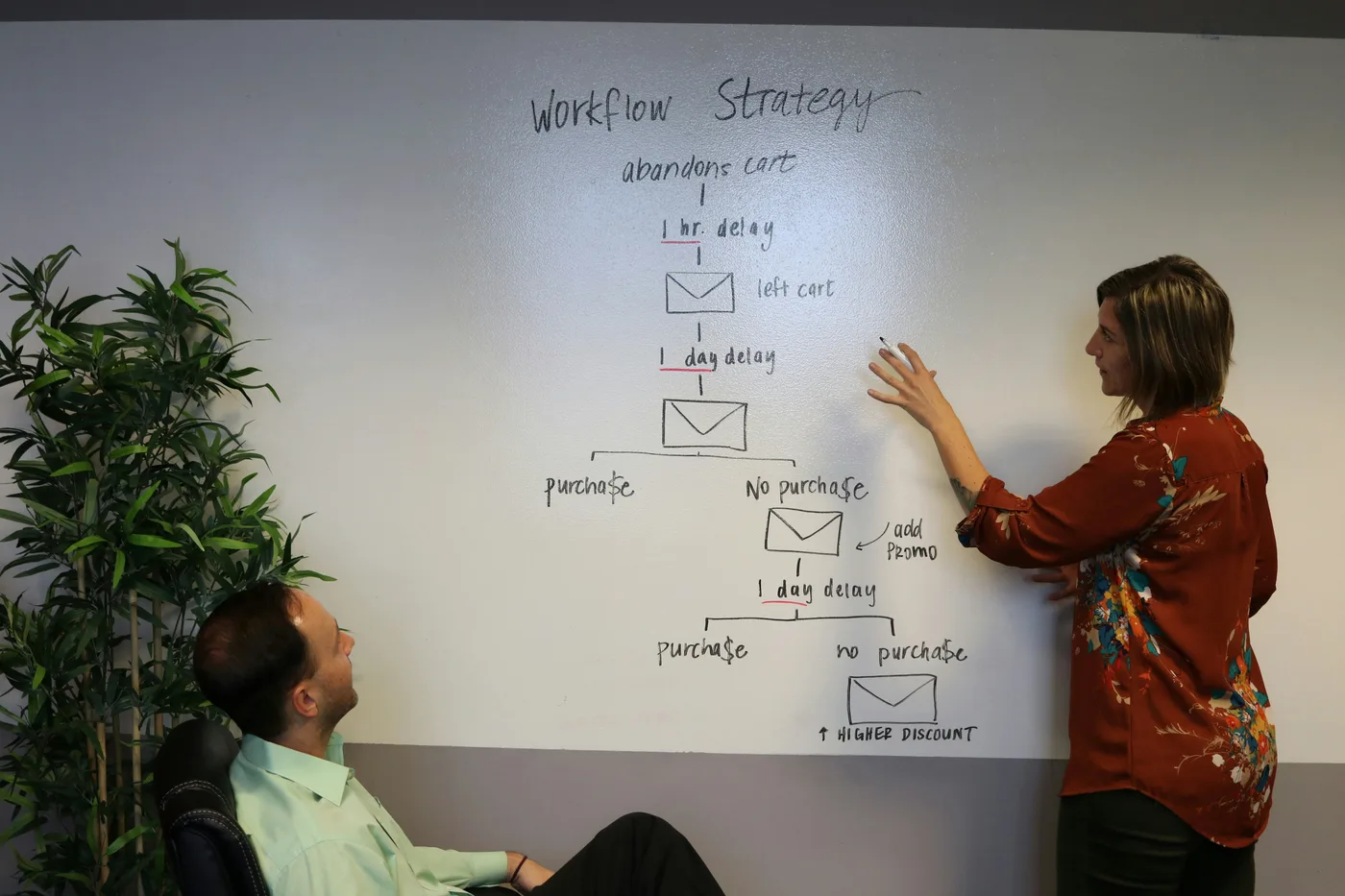
The email automation strategies that drive the most conversions include abandoned cart emails — which recover shoppers who left without purchasing — transactional emails that confirm actions and suggest next steps, and drip campaigns that nurture leads through a timed sequence of relevant messages. These automated emails feel timely and personal because they are triggered by subscriber behaviour, making recipients far more likely to engage and convert than with generic broadcast emails.
Effective email subject lines are concise, action-oriented, and relevant to the recipient. Aim for 30 to 50 characters to ensure full visibility on mobile devices. Avoid vague or overly promotional language that triggers spam filters. Personalisation — such as including the recipient's name or referencing a recent action — can significantly lift open rates. A/B testing different subject line styles is the most reliable way to discover what resonates with your specific audience.
Email marketing and SEO complement each other by driving traffic to the same high-value landing pages. SEO brings new visitors to your site organically, while email marketing re-engages existing subscribers and directs them back to conversion-optimised pages. Using UTM parameters and Google's Campaign URL Builder in your email links allows you to track exactly how much website traffic and how many conversions your email campaigns generate, giving you a complete picture of combined ROI.
Nearly half of all emails are opened on mobile devices, making mobile-responsive design essential for maintaining conversion rates. Emails that are not optimised for mobile display poorly, with text that is too small to read, images that do not scale correctly, and CTA buttons that are difficult to tap. A mobile-first email design uses concise copy, short paragraphs, appropriately sized images, and large, tappable CTA buttons — all of which reduce friction and increase the likelihood of a conversion.
Vigorant is a growth marketing agency serving businesses across the United States. We build conversion-focused email strategies, SEO-aligned content, and high-performing websites — all within a human-led approach built for your business, your customers, and your growth objectives.