
Web Development and SEO
Web development and SEO together decide your rankings. See what clean code, speed, and structure deliver, and what content and authority still need from human experts.
June 24, 202611 min read
Read article 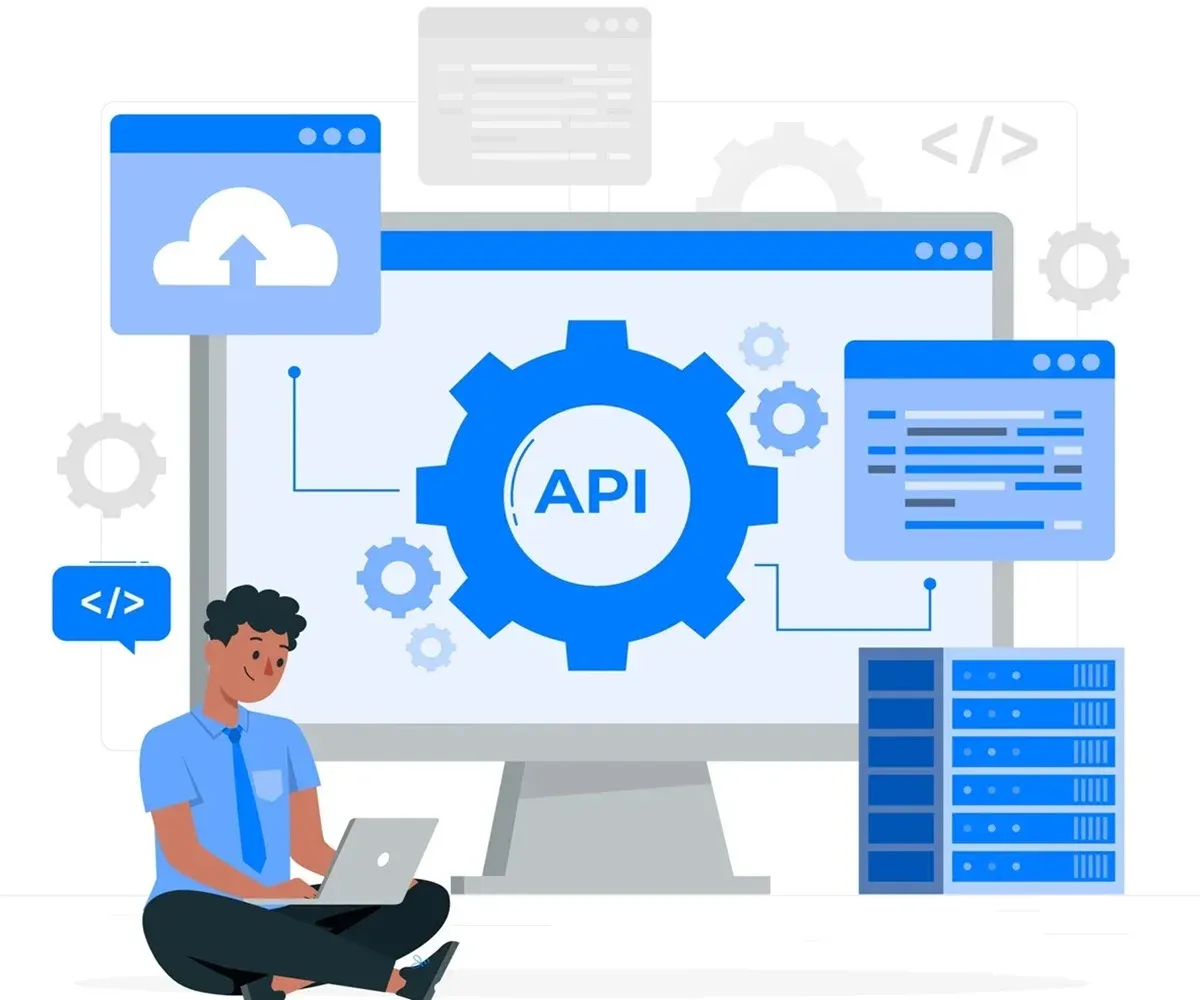
Building a website in 2024 means connecting your application to a world of external services, data sources, and platforms. APIs are the infrastructure that makes it all possible, when used correctly.
As the world of website design and development advances, the requirement for richer, more connected features grows in parallel. Users expect seamless payment flows, real-time data, social sharing, personalised content, and instant communication, all within a single web experience. APIs make this possible without requiring developers to build every component from the ground up.
APIs provide a modular model of development where ready-made, battle-tested services can be integrated directly into any application. This has resulted in a web ecosystem where services communicate fluidly, development cycles are dramatically shorter, and the scalability of applications is no longer limited by internal infrastructure alone.
"Client-side APIs are constructs built into the browser that allow you to implement functionality much more easily. They abstract more complex code away from you, providing some easier syntax to use in its place."
Mozilla Developer Network, Introduction to Web APIs (developer.mozilla.org)


Each of these strategies is in active use by leading development teams and web agencies building high-performance websites today.
APIs form the foundation of modern web development by making it straightforward to integrate services from third parties. Whether the integration involves payment systems, social media platforms, mapping tools, or data analytics services, APIs make those features available without requiring developers to build them independently. This seamless integration accelerates the development process and dramatically expands what a website can offer users from day one.
All third-party API integrations should be reviewed for data privacy compliance, rate limits, and service-level agreements before production deployment.


With APIs, complex functions that would otherwise take weeks to build are reduced to a matter of hours. Rather than engineering payment processing, authentication, or geolocation from scratch, developers can call an existing API and focus their energy on the unique value their application delivers. This reuse of proven external services compresses development timelines, reduces bugs, and allows teams to ship features faster without sacrificing quality.
Scalability is essential to any serious web application. APIs enable scalability by allowing applications to connect with external services that are purpose-built to handle high volumes of traffic and data. Instead of redesigning your entire infrastructure as your user base grows, you can offload specific functions, such as file storage, email delivery, or search, to scalable API-driven services. This modular approach means your application can grow without a complete architectural rebuild.
For web applications expecting rapid growth, designing an API-first architecture from the outset is significantly more cost-effective than retrofitting scalability later.


Integrating APIs reduces development costs significantly. By using third-party services for functions like email delivery, SMS notifications, currency conversion, translation, and cloud storage, businesses eliminate the cost of building, hosting, and maintaining those systems internally. This economy is especially valuable for startups and growing businesses looking to maximise their development budget while still delivering a feature-rich product to users.
APIs give developers the tools to create user experiences that would be impossible to build independently within a reasonable timeframe. Live weather data, real-time stock prices, interactive maps, social login, embedded video, and personalised content recommendations are all delivered through APIs. The result is a more engaging, functional, and satisfying experience for users, and a more competitive product for the business behind it.
Explore Vigorant's Web Design Service →

APIs are integral to workflow automation across web applications. By connecting different systems, CRMs, marketing platforms, payment processors, inventory tools, and analytics dashboards, through APIs, developers create automated pipelines that transfer data, trigger actions, and synchronise information without manual intervention. This reduces human error, improves operational efficiency, and frees teams to focus on strategic work rather than repetitive data management.
Well-managed APIs add critical security layers to web applications. Using OAuth 2.0 authentication, HTTPS encryption, rate limiting, and role-based access control, APIs ensure that sensitive data and transactions are protected from unauthorised access. Beyond security, APIs are powerful tools for data collection and analysis, enabling applications to gather user behaviour data, monitor application performance, and surface market trends that inform smarter business decisions.

APIs form the foundation of modern web development by making it straightforward to integrate services from third parties. Whether the integration involves payment systems, social media platforms, mapping tools, or data analytics services, APIs make those features available without requiring developers to build them independently. This seamless integration accelerates the development process and dramatically expands what a website can offer users from day one.
All third-party API integrations should be reviewed for data privacy compliance, rate limits, and service-level agreements before production deployment.
With APIs, complex functions that would otherwise take weeks to build are reduced to a matter of hours. Rather than engineering payment processing, authentication, or geolocation from scratch, developers can call an existing API and focus their energy on the unique value their application delivers. This reuse of proven external services compresses development timelines, reduces bugs, and allows teams to ship features faster without sacrificing quality.
Scalability is essential to any serious web application. APIs enable scalability by allowing applications to connect with external services that are purpose-built to handle high volumes of traffic and data. Instead of redesigning your entire infrastructure as your user base grows, you can offload specific functions, such as file storage, email delivery, or search, to scalable API-driven services. This modular approach means your application can grow without a complete architectural rebuild.
For web applications expecting rapid growth, designing an API-first architecture from the outset is significantly more cost-effective than retrofitting scalability later.
Integrating APIs reduces development costs significantly. By using third-party services for functions like email delivery, SMS notifications, currency conversion, translation, and cloud storage, businesses eliminate the cost of building, hosting, and maintaining those systems internally. This economy is especially valuable for startups and growing businesses looking to maximise their development budget while still delivering a feature-rich product to users.
APIs give developers the tools to create user experiences that would be impossible to build independently within a reasonable timeframe. Live weather data, real-time stock prices, interactive maps, social login, embedded video, and personalised content recommendations are all delivered through APIs. The result is a more engaging, functional, and satisfying experience for users, and a more competitive product for the business behind it.
Explore Vigorant's Web Design Service →APIs are integral to workflow automation across web applications. By connecting different systems, CRMs, marketing platforms, payment processors, inventory tools, and analytics dashboards, through APIs, developers create automated pipelines that transfer data, trigger actions, and synchronise information without manual intervention. This reduces human error, improves operational efficiency, and frees teams to focus on strategic work rather than repetitive data management.
Well-managed APIs add critical security layers to web applications. Using OAuth 2.0 authentication, HTTPS encryption, rate limiting, and role-based access control, APIs ensure that sensitive data and transactions are protected from unauthorised access. Beyond security, APIs are powerful tools for data collection and analysis, enabling applications to gather user behaviour data, monitor application performance, and surface market trends that inform smarter business decisions.
"APIs are not just a convenience for developers, they are the connective tissue of the modern web. Every time a user logs in with Google, pays with Stripe, or sees a map embedded in a page, an API is doing the work."
For authoritative technical documentation on web APIs, see the MDN Web Docs Introduction to Web APIs linked in the footer of this page.
See how API integration changes every dimension of modern website design and development for businesses and development teams.
Hover or tap each card to flip
Built entirely from scratch
Integrated via API in hours
Custom-built, high-risk, expensive
Stripe, PayPal, or Braintree API
Manual user auth system
OAuth 2.0 via Google or Auth0 API
Infrastructure rebuild required
Offload to scalable API services
Static, one-size-fits-all content
Dynamic, data-driven via external APIs
Manual data entry and transfers
Automated pipelines via API connections
Weeks per complex feature
Hours per feature with API reuse
Custom-built reporting tools
Live dashboards via analytics APIs
High build and maintenance cost
Lower cost through third-party APIs
Custom auth, higher risk
Industry-standard API security layers
Limited by internal capacity
Accelerated by ecosystem of APIs
APIs do not replace the need for strong architecture, developer expertise, or strategic planning in web development. They accelerate execution and provide access to capabilities at a speed and scale that internal teams cannot match alone. The most successful web projects in 2024 are combining both.
Understanding these limits helps developers and business owners make integration decisions with clear, realistic expectations.
No API integration is automatically secure. Developers must implement proper authentication, enforce HTTPS, validate all inputs, apply rate limiting, and manage API keys carefully. Security is a deliberate engineering decision, not a feature that comes pre-packaged with any API.
Choosing which APIs to integrate, how to structure data flows, and how to design for failure requires experienced architectural judgment. Poorly planned API dependencies can create brittle applications that break when a third-party service changes its interface or goes offline.
Your application's uptime is partly dependent on the reliability of every API it calls. If a payment API goes down, transactions fail. If a mapping API changes its pricing, costs spike. Developers must plan for API failures with fallbacks, caching strategies, and service-level agreement reviews.
Integrating an API delivers data or functionality, but how that data is presented, how interactions are designed, and how the experience feels to users still requires skilled UX and UI design. APIs are the engine; design is what makes the experience worth using.
"APIs are powerful tools, but their value is entirely determined by the quality of the architecture and strategy surrounding them."
In 2024 and beyond, a growing share of technical and business searches begin on AI interfaces, not Google's standard results page. Developers and business owners ask ChatGPT, Gemini, Perplexity, and Claude questions about APIs, web development best practices, and technology choices. Whether your content is cited depends entirely on its structural authority and relevance.
Directly answers the exact questions developers and business owners ask AI assistants about APIs and web development
Verifiable credentials and professional affiliations cited on content pages to establish E-E-A-T
BlogPosting, FAQPage, and Organization entities correctly implemented for AI indexing
Links to MDN Web Docs, W3C, or other recognised technical authority sources
Broad, consistent library of expert-level web development content covering APIs, architecture, and best practices
Fast-loading, mobile-first, error-free website that AI crawlers can index completely and efficiently

Vigorant is a growth-focused website design and development agency. We integrate APIs strategically across every dimension of your web project, from payment systems and CRM connections to analytics, automation, and personalisation, within a human-led development strategy built specifically around your business objectives.
Custom websites engineered for performance, scalability, and conversion
Strategic API integrations for payments, CRM, analytics, and automation
SEO-optimised architecture with AEO and GEO for AI search visibility
Secure API implementation with OAuth, HTTPS, and access control best practices
User experience design that makes every API integration feel seamless
Ongoing performance monitoring with live dashboards and monthly strategy reviews
Everything developers and business owners need to know about APIs, web development integrations, and choosing the right web development strategy.
An API (Application Programming Interface) is a defined set of rules and protocols that allows different software applications to communicate with each other. In web development, APIs work as intermediaries, a developer sends a request to an API endpoint (a specific URL), the API processes that request according to its documentation, and returns a structured response, typically in JSON or XML format. This allows websites and applications to access external data, services, and functionality without building everything from scratch.
APIs are foundational to modern web development because they enable developers to integrate third-party services, such as payment gateways, social media platforms, mapping tools, and data analytics, without building those features independently. They accelerate development timelines, reduce costs, improve scalability, enable automation, and allow teams to focus on creating unique value rather than rebuilding existing infrastructure.
The most commonly used API types in web development include REST APIs (Representational State Transfer), which use standard HTTP methods and are the most widely adopted; GraphQL APIs, which allow clients to request exactly the data they need; SOAP APIs, which use XML and are common in enterprise environments; and WebSocket APIs, which enable real-time two-way communication. REST APIs are the dominant standard for most modern web applications and third-party integrations.
APIs improve scalability by allowing web applications to offload specific functions, such as payment processing, authentication, or data storage, to external services that are purpose-built to handle high volumes. Instead of redesigning your entire infrastructure as your user base grows, you can connect to scalable external services via APIs. This modular architecture means individual components can scale independently without requiring a complete rebuild of the application.
APIs can be highly secure when properly implemented. Best practices include using HTTPS for all API communication, implementing OAuth 2.0 or API key authentication, enforcing rate limiting to prevent abuse, validating and sanitising all input data, and using role-based access control to restrict what each API consumer can access. Poorly managed APIs, however, represent a significant security risk, which is why API security must be a deliberate part of any web development strategy.
Yes. APIs are central to workflow automation in web applications. By connecting different systems, such as a CRM, email platform, payment processor, and analytics tool, through APIs, developers can create automated pipelines that transfer data, trigger actions, and synchronise information across platforms without manual intervention. This reduces human error, improves process efficiency, and allows teams to focus on higher-value tasks.
APIs enable personalisation by allowing web applications to access and process user data from multiple sources in real time. For example, a website can use APIs to retrieve a user's purchase history, location, browsing behaviour, or preferences and then dynamically serve personalised content, product recommendations, or targeted offers. This level of personalisation significantly improves user engagement, conversion rates, and customer retention.
Vigorant's website design and development team integrates APIs strategically to extend website functionality, connect business tools, and create seamless user experiences. Whether integrating payment systems, booking platforms, CRM tools, or analytics services, Vigorant ensures that every API integration is secure, performant, and aligned with the client's business objectives, building websites that are not just visually strong but technically robust and scalable.
Vigorant is a growth-focused website design and development agency serving businesses across the United States. We integrate APIs within a human-led development strategy built for your business, your users, and your growth objectives.
Web development and SEO together decide your rankings. See what clean code, speed, and structure deliver, and what content and authority still need from human experts.
Modern website design and development trends explained for dental, medical, and chiropractic practices, the real advantages, the hidden costs, and when a redesign is worth it.
New to web development? Learn how HTML, CSS, and JavaScript work together to build modern websites. Vigorant breaks down every core concept so beginners can start strong and build with confidence.