Healthcare Marketing

    Types of Google Ads Campaigns: Advantages, Disadvantages & What Healthcare Practices Need to Know

    Search, Performance Max, Display, Video, Demand Gen — each Google Ads campaign type promises growth. But for dental, medical, and chiropractic practices, choosing the wrong one quietly drains budget while booking no patients.

    Vigorant Healthcare Marketing TeamJune 202610 min read
    Healthcare practice owner reviewing Google Ads campaign performance on a laptop dashboard
    • Published:June 24, 2026
    • Author:Vigorant Healthcare Marketing Team
    • Category:Healthcare Marketing · Paid Advertising · Google Ads
    The Landscape Explained

    What Are the Types of Google Ads Campaigns?

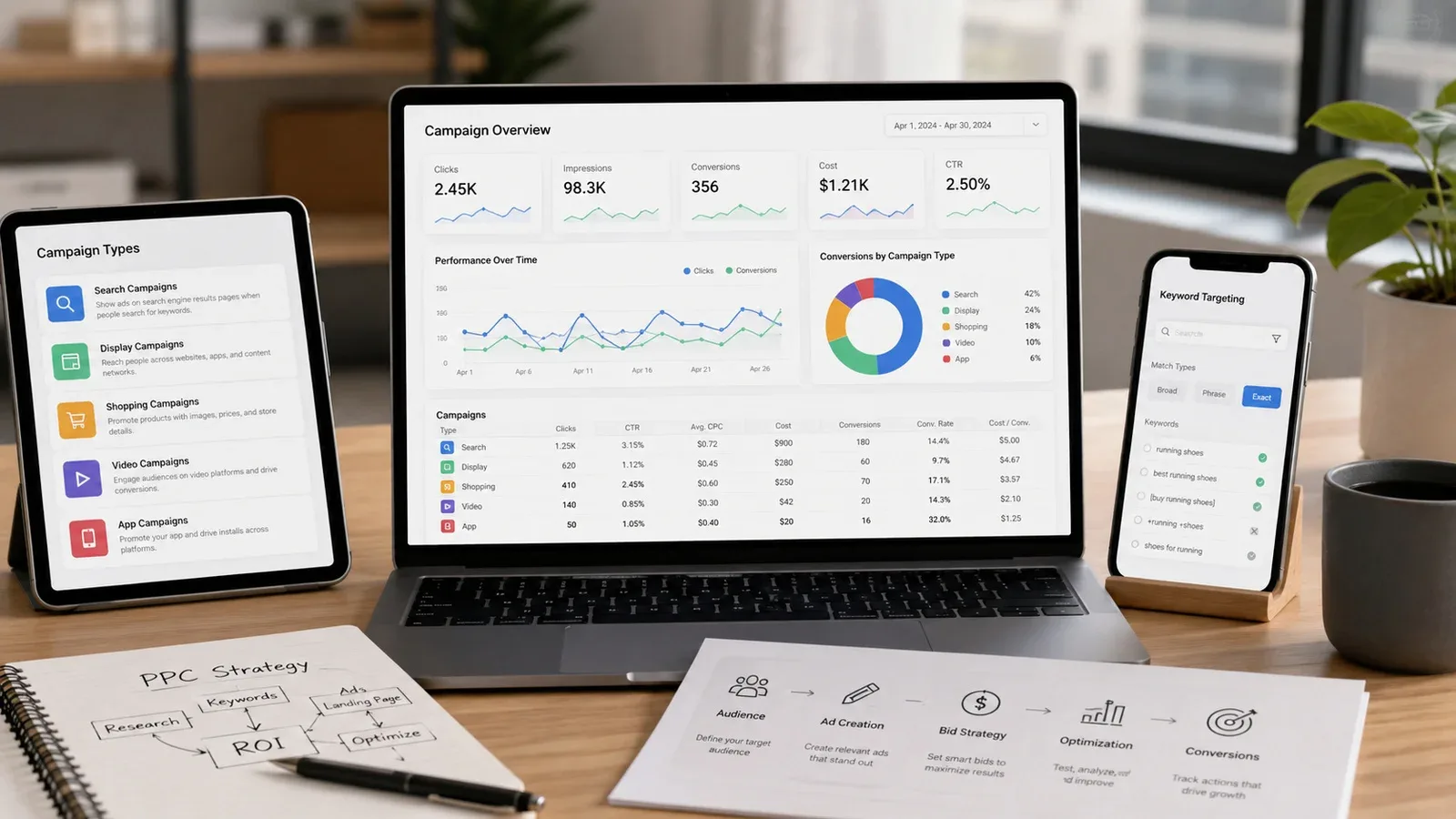
    Google Ads runs on a pay-per-click (PPC) model: you only pay when someone clicks your ad. For dental, medical, and chiropractic practices, that promise of measurable, demand-driven advertising is compelling. But Google Ads is not one thing. It is a family of distinct campaign types — each built for a different goal, audience, and stage of the patient journey. Choosing the right ones is the difference between booked appointments and burned budget.

    Broadly, the campaign types fall into two camps. The first is manually managed, intent-driven campaigns — Search and Shopping — where you bid on specific keywords or products and capture patients at the exact moment they are looking for care. The second is automated, reach-driven campaigns — Performance Max, Demand Gen, Display, and Video on YouTube — where Google's AI distributes your ads across its networks to build awareness and find new audiences.

    Most practices do not need every campaign type. They need the right two or three, configured around conversion tracking that measures real new patients rather than vanity clicks. Understanding what each type does well — and where each one fails — is the foundation of a paid strategy that actually grows a practice.

    "Choosing a campaign type is one of the most important decisions you make in Google Ads, because it determines where your ads can show and how Google optimizes your bids."

    Google Ads analytics and campaign performance charts displayed on a screen
    The Upside

    Advantages of Running the Right Google Ads Campaign Types

    Where a well-matched campaign type genuinely delivers value — especially for practices that need predictable, trackable patient flow.

    01

    Capture High-Intent Demand Instantly

    Search campaigns place your practice in front of patients at the precise moment they type 'emergency dentist near me' or 'chiropractor for back pain.' Unlike awareness channels, intent-driven campaign types reach people already looking for care — which is why Search so often produces the fastest, most qualified new patient calls.

    02

    Pay Only for Performance

    Because Google Ads runs on a pay-per-click model, you are charged only when someone engages with your ad. With conversion tracking in place, this lets a practice tie spend to booked appointments and calculate a real cost per new patient — a level of accountability traditional advertising rarely offers.

    03

    Reach Patients on Every Device and Network

    Automated campaign types like Performance Max and Demand Gen extend a single setup across Search, YouTube, Display, Gmail, Discover, and Maps. With most healthcare searches now starting on mobile, this multi-surface reach helps a growing practice stay visible wherever patients research and compare providers.

    04

    Granular Control and Negative Keywords

    Manually managed Search and Shopping campaigns let you choose exactly which queries trigger ads and exclude irrelevant ones with negative keywords. For healthcare, this control is critical — it prevents budget from leaking on job seekers, students, or out-of-area searches and keeps spend focused on real prospective patients.

    05

    Rich Performance Insights to Optimize

    Every campaign type feeds Google's reporting dashboard with click, conversion, and audience data. These insights reveal which keywords, creatives, and audiences book patients — and which waste money. Used well, they turn advertising from guesswork into a continuously improving, data-driven patient acquisition engine.

    Marketing analytics dashboard showing advertising campaign performance metrics
    Key Insight

    "In healthcare, a campaign that earns clicks but not appointments is not a marketing win — it is a budget leak measured in unbooked patients."

    The Risks

    Disadvantages and Pitfalls of Google Ads Campaign Types

    Where the wrong campaign type — or the wrong setup — creates wasted spend, compliance exposure, and patient acquisition risk that practice owners must understand.

    Practice team reviewing advertising budget and campaign data in a meeting

    Automated Campaigns Hide Where Your Money Goes

    Performance Max and Smart campaigns hand bidding, targeting, and placement to Google's AI. The reach is broad, but transparency is limited — you often cannot see which search terms, placements, or audiences consumed your budget. For a practice trying to control cost per new patient, that black box can quietly funnel spend into low-intent traffic that never books.

    Wrong Campaign Type for the Goal

    A common mistake is using awareness-oriented types to chase immediate bookings, or expecting Search alone to build long-term brand demand. Matching the campaign type to the actual goal is what separates profitable accounts from wasteful ones.
    Search for high-intent capturePerformance Max for scaled reachVideo for awareness and trustDisplay for remarketingDemand Gen for discoveryLocal for store/clinic visits

    HIPAA-Awareness and Patient Data Gaps

    Google Ads is a general advertising platform, not a healthcare compliance tool. Practices that pass patient information into ad platforms through forms, call tracking, or conversion tags can inadvertently create HIPAA exposure.
    • Never pass protected health information (PHI) into ad or analytics platforms
    • Use HIPAA-aware call tracking and form tools with appropriate agreements
    • Configure conversion tracking that avoids transmitting sensitive details
    • Review platform data-sharing terms and update as policies change

    Healthcare Ad Policy Restrictions

    Google enforces strict advertising policies around healthcare, medications, and certain treatments, and some campaign types or claims require certification or are limited. Practices that ignore these rules risk disapproved ads, suspended accounts, and lost momentum during peak demand. Reputable advertising never promises guaranteed rankings, leads, or treatment outcomes.

    Clicks Without Conversions

    Plenty of practices report 'clicks but no patients.' The culprit is rarely budget — it is a disconnect between campaign type, keyword intent, and the landing experience. A great ad pointed at a slow, generic, or hard-to-book page wastes every click.

    "Marketers consistently rank measuring ROI and converting traffic into qualified leads among their top digital advertising challenges."

    Industry research summarized by the U.S. Small Business Administration

    Ongoing Management Is Non-Optional

    Google Ads is not a set-and-forget channel. Bids shift, competitors enter, search terms drift, and automated campaigns retrain on new data. Without continuous negative-keyword pruning, A/B testing of creatives, landing page optimization, and conversion analysis, even a well-built account erodes over time — turning a profitable campaign into a slow, expensive leak.
    Head-to-Head

    Automated vs. Manually Managed Google Ads Campaigns

    How automated, AI-driven campaign types (such as Performance Max and Smart) compare to manually managed, intent-driven campaigns (such as Search and Shopping) across the criteria that matter most for patient acquisition.

    CriteriaManually Managed (Search / Shopping)Automated (Performance Max / Smart)
    Speed to LaunchModerate — keyword & ad setupFast — guided automated setup
    Network ReachFocused — Search & ShoppingBroad — Search, YouTube, Display, Gmail, Maps
    Targeting ControlHigh — keywords & negativesLow — Google AI decides
    Spend TransparencyClear — query-level dataLimited — black-box placements
    Intent QualityHigh — active searchersMixed — includes low intent
    Negative Keyword ControlFull controlRestricted in automation
    Setup ComplexityHigher — needs expertiseLower — guided wizard
    Healthcare Compliance RiskManageable with controlsHigher — harder to audit
    Awareness & DiscoveryLimitedStrong — multi-surface
    Cost-Per-Patient VisibilityStrong with trackingHarder to attribute
    Optimization EffortHands-on, ongoingAutomated but needs guardrails
    Best ForHigh-intent patient captureScaled reach & awareness

    Automated campaign types can scale reach quickly, but for healthcare practices the most reliable new-patient results usually start with tightly managed, intent-driven Search campaigns — then layer automation on top with strong conversion tracking and exclusions.

    Decision Guide

    When to DIY Google Ads — and When You Cannot Afford To

    ✓ Self-Managed Campaigns Make Sense For:

    • A single-location practice testing demand with a small, capped Search budget
    • A simple awareness push around one service, event, or seasonal promotion
    • An owner with time to monitor search terms, negatives, and conversions weekly
    • A market with low competition where a basic, well-tracked campaign can perform

    ⚠ Expert Management Is Non-Negotiable When:

    • Ad funnels collect patient contact details, appointment requests, or intake data
    • You run multiple locations, specialties, or several campaign types at once
    • You compete in high-density local markets where bid and intent precision decide winners
    • Paid ads are a primary new-patient acquisition channel your revenue depends on
    • You must navigate healthcare ad policies, HIPAA-aware tracking, or state privacy laws
    Vigorant's Approach

    How Vigorant Builds Google Ads Campaigns That Book Patients

    Vigorant's approach to Google Ads is built on a principle automation alone cannot replicate: deep healthcare domain expertise combined with a rigorous, conversion-focused process engineered specifically for dental, medical, and chiropractic practices.

    • Campaign-type strategy mapped to your goals — Search for intent, automation for scale

    • Disciplined negative-keyword and exclusion management to protect every dollar of budget

    • HIPAA-aware call tracking, form handling, and conversion setup reviewed before launch

    • Conversion-optimized landing pages built around the patient's booking decision, not vanity clicks

    • Continuous optimization with A/B testing, bid management, and real cost-per-patient reporting

    • Integration with SEO and AEO so paid insights feed long-term, lower-cost patient acquisition

    Healthcare marketing agency team planning a Google Ads campaign strategy for a dental practice
    AI Search Visibility

    The GEO / AIO Factor: Paid Ads Meet AI Search

    Paid advertising no longer lives in a vacuum. As patients increasingly ask AI assistants for recommendations, Generative Engine Optimization (GEO) — structuring content so AI-powered search surfaces your practice in generated answers — has become a decisive complement to Google Ads. When someone asks ChatGPT, Google Gemini, Perplexity, or Microsoft Copilot 'What's the best dentist near me for implants?', the AI assembles its answer from authoritative web content, not your ad spend. The keywords and messages that convert in your campaigns reveal exactly what patients ask AI — and the same structured, credentialed content fuels both channels.

    ChatGPTGoogle GeminiPerplexityMicrosoft CopilotClaude

    Conversion data from ads mapped to the questions patients ask AI assistants

    Clearly structured FAQ content with specific, authoritative answers

    Named clinical authors with verified credential information

    Schema.org markup identifying content type, publisher, and subject

    External citations from credible, institutional sources

    Google Ads alone cannot make a practice visible in AI-generated answers. Pairing intent-driven campaigns with GEO and content strategy is increasingly a decisive competitive factor in healthcare markets.

    FAQ

    Frequently Asked Questions

    Everything healthcare practice owners need to know about Google Ads campaign types, budgeting, compliance, and when to invest in specialist expertise.

    Google Ads currently offers several core campaign types: Search, Performance Max, Display, Video (YouTube), Demand Gen, Shopping, App, and Local/Smart campaigns. For most dental, medical, and chiropractic practices, Search and Performance Max do the heaviest lifting, with Video and Display supporting awareness. The right mix depends on your goals, budget, and how patients in your market search for care.

    Ready to Grow?

    Picking the Right Campaign Type Is Where Patient Growth Begins.

    If your dental, medical, or chiropractic practice is ready to turn Google Ads spend into booked appointments — with the right campaign types, HIPAA-aware tracking, and conversion-first landing pages — Vigorant is ready to help.

    • HIPAA-Aware Tracking
    • Healthcare-Exclusive Agency
    • Conversion-First Campaigns