Healthcare Marketing

    Paid Ads and SEO: Advantages, Disadvantages & 6 Ways to Integrate Them for Long-Term Results

    Paid ads deliver speed. SEO delivers staying power. For dental, medical, and chiropractic practices, the biggest growth comes from knowing how to combine them — not from choosing a side.

    Vigorant Healthcare Marketing TeamSeptember 202510 min read
    Healthcare practice owner reviewing paid ads and SEO performance data on a laptop dashboard
    • Published:September 17, 2025
    • Author:Vigorant Healthcare Marketing Team
    • Category:Healthcare Marketing · SEO · Paid Ads
    The Strategy Explained

    Why Paid Ads and SEO Work Better Together

    In the competitive healthcare landscape, online visibility decides whether a prospective patient finds your practice or clicks through to a competitor. Many practice owners ask the same question: should we prioritize search engine optimization or invest in paid ads? The honest answer is that the strongest, most durable growth rarely comes from choosing one channel. It comes from integrating paid ads with SEO into a single long-term digital marketing strategy.

    Consider how patients actually search. Someone with a dental emergency may click the first paid ad they see and book within minutes. Another patient researching implants, orthodontics, or a specialist physician may read several pages, compare practices, and convert organically days later. A cross-channel approach ensures both of these patients find you at the right moment, across both the paid results and the organic listings.

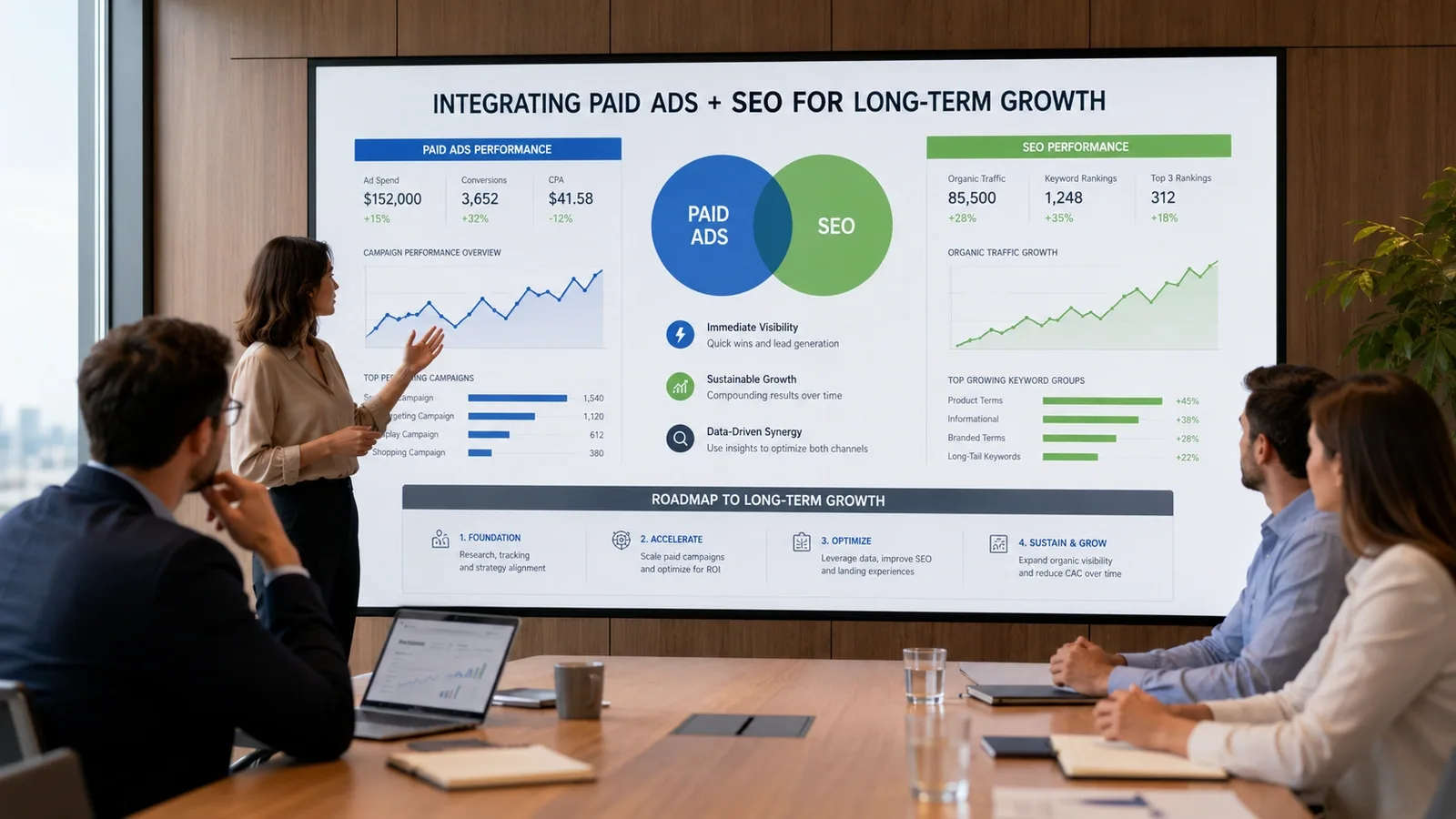
    Organic search builds long-term authority and lowers your cost per acquisition over time, while paid ads generate instant, controllable visibility. When practices create genuine SEO and PPC synergy — aligning goals, messaging, and measurement — they get the best of both: immediate patient acquisition today and compounding organic growth that keeps working long after a campaign budget is spent.

    "SEO is about helping search engines understand and present content. Your site might be smaller or larger than our example site and offer vastly different content, but the optimization topics we discuss apply to sites of all sizes and types."

    Marketing dashboard comparing paid ad performance and organic search rankings side by side
    The Upside

    6 Advantages of Integrating Paid Ads With Your SEO

    Where combining PPC and SEO genuinely outperforms running either channel on its own — especially for practices focused on sustainable, measurable patient growth.

    01

    Keyword Data Sharing Between Channels

    Paid campaigns reveal in real time which search terms generate clicks, strong Quality Scores, and conversions. If 'same-day crowns' converts patients efficiently in your ads, that exact term can guide blog posts, service pages, and Google Business Profile optimization. SEO, in turn, surfaces long-tail queries you can promote to new ad groups — creating a continuous feedback loop.

    02

    Broader Coverage of the Results Page

    Appearing in both the paid results and the organic listings increases your share of the search engine results page. Dual visibility reinforces brand recall, captures patients who skip ads as well as those who click them, and makes a practice look more established. The combined click-through often exceeds what either listing earns alone.

    03

    Consistent Content and Ad Messaging

    When ad copy and meta descriptions mirror each other in tone and value proposition, patients experience a seamless journey from query to landing page. If an ad promotes 'affordable implants with flexible financing,' the page must reflect it. This alignment of content and ad messaging builds trust and lifts conversion rates at every touchpoint.

    04

    Stronger Local Visibility

    Patients search for specific treatments within a radius, not just 'dentist near me.' Pairing an optimized Google Business Profile and local landing pages with geo-targeted paid ads lets a practice appear in both the map pack and the paid results for the same area — doubling visibility and increasing the odds of capturing patients ready to book.

    05

    Smarter, More Efficient Budget Allocation

    Integration makes spending strategic. Rather than buying clicks on terms you already rank for organically, paid budget can target competitive or seasonal keywords while SEO strengthens broader categories. As organic rankings mature, reliance on paid clicks for core services drops, reducing overall cost per acquisition over time.

    06

    Stability and Long-Term Scalability

    Paid ads stop the moment the budget does; SEO can take months to build. A strategy that integrates both bridges the gap — ads carry near-term patient flow while organic authority compounds in the background. The result is a patient acquisition funnel that stays resilient even as algorithms shift or bidding costs rise.

    Healthcare marketing team analyzing combined search performance metrics on screens
    Key Insight

    "Paid ads buy attention today; SEO earns trust that lasts. Practices that treat them as one system, rather than two competing budgets, capture patients at every stage of the search journey."

    The Risks

    The Disadvantages of Keeping Paid Ads and SEO in Separate Silos

    Where running PPC and SEO as disconnected efforts creates wasted spend, mixed messaging, and missed patient-acquisition opportunities that practice owners must understand.

    Healthcare practice team reviewing fragmented marketing reports and disconnected channel data

    Wasted Budget and Internal Competition

    When ads and SEO are managed in isolation, practices often pay for clicks on keywords they already rank for organically, cannibalizing free traffic with paid spend. Without coordination, the two channels can bid against the same intent without anyone reconciling where each dollar performs best. Over time this quietly inflates cost per acquisition.
    Paying for owned keywordsNo shared budget planHigher CPA

    Inconsistent Messaging Across the Journey

    If a paid ad promises something the organic landing page never mentions, patients feel a disconnect that erodes trust. Siloed teams frequently produce ad copy and website content that use different tone, offers, and terminology — weakening brand identity and dropping conversion rates precisely where the patient is closest to booking.
    Off-message adsMismatched offersLower conversion

    Lost Keyword Intelligence

    Paid campaigns generate rich conversion data; SEO uncovers valuable long-tail demand. When the two channels never share insights, that intelligence is stranded. Practices end up guessing at content priorities while their own ad account already holds the answer about which terms turn searchers into patients.
    No data feedback loopGuesswork contentUntapped long-tail

    Fragmented, Inaccurate Measurement

    A patient may notice an ad for 'emergency dental care,' then later search the practice by name and book through local search. If paid and organic are measured separately, that journey is invisible — making it nearly impossible to evaluate true marketing ROI or to understand brand lift across channels.
    Hidden patient journeysMisattributed ROINo brand-lift view

    Over-Reliance on a Single Channel

    Leaning only on paid ads means visibility vanishes the moment spending stops, and costs climb as competition rises. Leaning only on SEO leaves a practice exposed during the months it takes to build momentum, and vulnerable to algorithm updates. Neither extreme delivers the stability a growing practice needs.

    "Good SEO practices improve site usability and the experience of people coming to your site, but search engines are also a key source of traffic that you don't control directly."

    Google Search Central — SEO Starter Guide (2024)

    Compliance and Tracking Blind Spots

    Healthcare campaigns that collect appointment requests or intake data carry HIPAA obligations. When ads, analytics, and the website are managed by disconnected teams, remarketing tags and conversion tracking can be configured without anyone reviewing how patient information flows — creating avoidable privacy and compliance exposure.
    Unreviewed trackingHIPAA exposureNo single owner
    Head-to-Head

    Siloed Channels vs. Integrated Paid + SEO: The Complete Comparison

    How running paid ads and SEO as separate efforts compares to an integrated strategy across the criteria that matter most for healthcare patient acquisition.

    CriteriaPaid Ads & SEO in SilosIntegrated Paid + SEO Strategy
    Speed to First ResultsFast (ads) or slow (SEO) — not bothFast now via ads, durable later via SEO
    Cost Per Acquisition Over TimeStays high; pays for owned keywordsDeclines as SEO offsets paid spend
    Keyword IntelligenceTrapped within each channelShared data feedback loop
    Results-Page CoverageSingle listing at a timePaid + organic dual presence
    Messaging ConsistencyRisk of mismatched ad and page copyAligned ad copy and content
    Local VisibilityMap pack or ads, rarely bothMap pack and ads in same area
    Measurement & AttributionFragmented, journeys hiddenUnified, cross-channel view
    Budget AllocationChannels compete for spendSpend directed where it performs
    Resilience to Algorithm ShiftsExposed if one channel faltersDiversified, more stable
    Brand Trust SignalsInconsistent across touchpointsReinforced at every stage
    Compliance OversightNo single owner of trackingCoordinated, reviewable setup
    Best ForQuick tests or single tacticsPractices wanting long-term growth

    Running a single channel can make sense for a short test or a narrow campaign. For healthcare practices with real growth ambitions, integrating paid ads and SEO consistently outperforms siloed efforts across the dimensions that drive durable patient acquisition.

    Decision Guide

    When a Single Channel Is Enough — and When Integration Is Essential

    ✓ A Single Channel Can Work For:

    • A one-off seasonal or event promotion that only needs short-term paid visibility
    • An early-stage practice with a tiny budget testing whether a service line has demand
    • A content-only informational page where organic SEO is the sole objective
    • A practice in a low-competition market where organic rankings come quickly and cheaply

    ⚠ Integrating Paid Ads + SEO Is Essential When:

    • Your website is a primary new-patient acquisition channel you depend on month over month
    • You operate in a high-density local market where competitors bid and rank aggressively
    • You run multi-location dental groups, medical group practices, or growing chiropractic networks
    • You want to lower cost per acquisition over time rather than paying for clicks indefinitely
    • You collect appointment requests or intake data and need coordinated, HIPAA-aware tracking
    Vigorant's Approach

    How Vigorant Integrates Paid Ads and SEO to Drive Patient Growth

    Vigorant's approach to search marketing is built on one principle: paid ads and SEO are not competing budgets but a single growth system. We engineer the two channels to share data, mirror messaging, and compound — specifically for dental, medical, and chiropractic practices.

    • A shared keyword strategy so paid conversion data continuously informs SEO content and pages

    • Aligned ad copy and on-page messaging that keeps the patient journey consistent and trustworthy

    • Local pack and geo-targeted paid coverage so you appear in both map results and paid listings

    • Strategic budget allocation that shifts spend toward competitive terms as organic rankings mature

    • Unified, cross-channel measurement so you can see true ROI and brand lift, not fragmented numbers

    • HIPAA-aware conversion tracking and remarketing reviewed before any campaign goes live

    Healthcare marketing agency team aligning paid ads and SEO strategy for a dental practice
    AI Search Visibility

    The GEO / AIO Factor: Paid Ads and SEO in the Age of AI Search

    Search no longer ends at the classic results page. When a prospective patient asks ChatGPT, Google Gemini, Claude, Perplexity, or Microsoft Copilot 'Who is a good dentist in [city] for implants?', the AI assembles its answer from web content it has indexed and judged authoritative. This is Generative Engine Optimization (GEO) — structuring content so AI assistants surface your practice. Crucially, the keyword and conversion intelligence your paid ads produce is exactly what tells you which questions to answer in the structured, authoritative content that AI engines reward.

    ChatGPTGoogle GeminiPerplexityMicrosoft CopilotClaude

    Clearly structured FAQ content answering the high-intent questions your ads reveal convert

    Named clinical authors with verified credential information for E-E-A-T

    Schema.org markup identifying content type, publisher, and subject

    External citations from credible, institutional sources

    Consistent paid and organic messaging that reinforces a single, authoritative brand voice

    Paid ads tell you what patients ask; GEO ensures AI assistants repeat your answer. Practices that feed paid keyword intelligence into structured, authoritative content gain an edge in AI search that siloed campaigns never reach.

    FAQ

    Frequently Asked Questions

    Everything healthcare practice owners need to know about integrating paid ads with SEO — from sequencing and budget to local visibility, ROI, and HIPAA-aware tracking.

    For most dental, medical, and chiropractic practices the strongest approach is not choosing one over the other but sequencing them together. Paid ads deliver immediate visibility and patient inquiries while SEO builds the long-term organic authority that lowers your cost per acquisition over time. A common path is to start paid campaigns for fast results, use the data they produce to guide your SEO content, and gradually shift budget toward the keywords where organic rankings mature.

    Ready to Grow?

    Stop Choosing Between Paid Ads and SEO. Start Integrating Them.

    If your dental, medical, or chiropractic practice is ready to turn two competing budgets into one growth engine — built for immediate visibility, lower long-term cost per acquisition, and durable patient flow — Vigorant is ready to help.

    • HIPAA-Aware Tracking
    • Healthcare-Exclusive Agency
    • Integrated Search Strategy