The Channel Every Practice Owner Is Weighing

    What Is Google Ads?

    The Short Answer

    Google Ads is Google's pay-per-click platform that puts your practice in front of patients at the exact moment they search — fast, measurable, and powerful when managed well.

    Vigorant Healthcare Marketing Team·June 2026·11 min read·Source: Google Ads Help
    $8
    in revenue is what businesses report earning on average for every $1 spent on Google Ads
    Google · Economic Impact Report
    Scroll for the full breakdown
    Search Ads
    Responsive Search Ads
    Display Ads
    Video Ads
    YouTube Campaigns
    Shopping Ads
    Performance Max
    Local Services Ads
    Call-Only Ads
    Keyword Bidding
    Audience Targeting
    Conversion Tracking
    Ad Extensions
    A/B Ad Testing
    Geo-Targeting
    Remarketing
    Search Ads
    Responsive Search Ads
    Display Ads
    Video Ads
    YouTube Campaigns
    Shopping Ads
    Performance Max
    Local Services Ads
    Call-Only Ads
    Keyword Bidding
    Audience Targeting
    Conversion Tracking
    Ad Extensions
    A/B Ad Testing
    Geo-Targeting
    Remarketing
    Google Ads Delivers This Well

    What Google Ads Can Actually Do

    Paid search excels at one thing above all: putting your practice in front of people who are actively searching for the care you provide, right now.

    Capture High-Intent Demand
    When a patient searches 'emergency dentist near me' or 'back pain specialist,' a well-targeted Search ad reaches them at the exact moment of intent — far closer to a booking than passive awareness advertising.
    Deliver Results Fast
    Unlike SEO, which compounds over months, ads can begin showing within hours of approval. That makes Google Ads ideal for launching a new service line or filling open appointment slots quickly.
    Precise Local & Audience Targeting
    Show ads only within your service radius, during your office hours, and to the demographics most likely to book — so budget concentrates on patients who can realistically walk through your door.
    Measurable, Trackable Spend
    Every click, call, and form submission can be tracked, so you can tie spend directly to patient inquiries and calculate true cost per acquisition rather than guessing at marketing ROI.
    Multiple Ad Formats
    Text Search ads, responsive ads that auto-test combinations, image-based Display ads, and YouTube video ads let you match the format to the goal — from direct response to brand awareness.
    Continuous Optimization Signals
    The platform surfaces performance data on keywords, audiences, and devices, giving a skilled manager the signals needed to shift budget toward what is actually producing booked patients.
    This Still Needs Strategy & Humans

    What Google Ads Can't Fix Alone

    Turning ad clicks into booked patients depends on factors the ad platform itself does not control — and several of them are unique to healthcare.

    A Weak Landing Page
    Ads send traffic to a page — if that page is slow, generic, or has no clear path to book, even perfect targeting wastes budget. Conversion-optimized landing pages do the heavy lifting that ads cannot.
    Healthcare Ad Compliance
    Google's healthcare advertising policy and FTC truth-in-advertising rules govern what you may claim. AI-default ad copy often crosses into unsubstantiated outcome promises that get ads disapproved or invite liability.
    Clinical Accuracy of Messaging
    Ad headlines and landing copy that describe procedures must be clinically accurate and avoid oversimplifying complex care. A qualified reviewer should approve messaging before it reaches a patient.
    Front-Desk Follow-Through
    A click becomes a patient only when someone answers the phone and books the visit. Ads can't compensate for missed calls, slow form responses, or a booking experience that frustrates prospective patients.
    Wasted Spend Without Oversight
    Broad keywords, missing negative keywords, and untracked conversions quietly drain budget. Without active management, a campaign can run for months looking 'busy' while producing few real inquiries.
    Long-Term Organic Authority
    The moment you pause ads, the traffic stops. Paid search rents visibility; it cannot build the durable organic authority and AI-search citations that keep generating patients without ongoing spend.
    The Evidence

    Why Paid Search Remains a Core Patient-Acquisition Channel

    Google processes billions of searches every day, and a large share carry local, service-oriented intent — exactly the queries that lead patients to a nearby provider. Google's own documentation describes Google Ads as a way to reach customers 'precisely when they're searching for the products and services you offer,' which is what makes it so effective for demand capture.

    For healthcare practices, that intent is unusually high-value: someone searching for an urgent dental issue or a specialist consultation is often ready to book the same week. The channel rewards practices that pair tight targeting with fast, compliant follow-up — and penalizes those that treat it as a set-and-forget billboard.

    "

    "Google Ads can help you reach the right people at the right time for your business — when they're searching for the products and services you offer."

    — Google · About Google Ads (Google Ads Help)

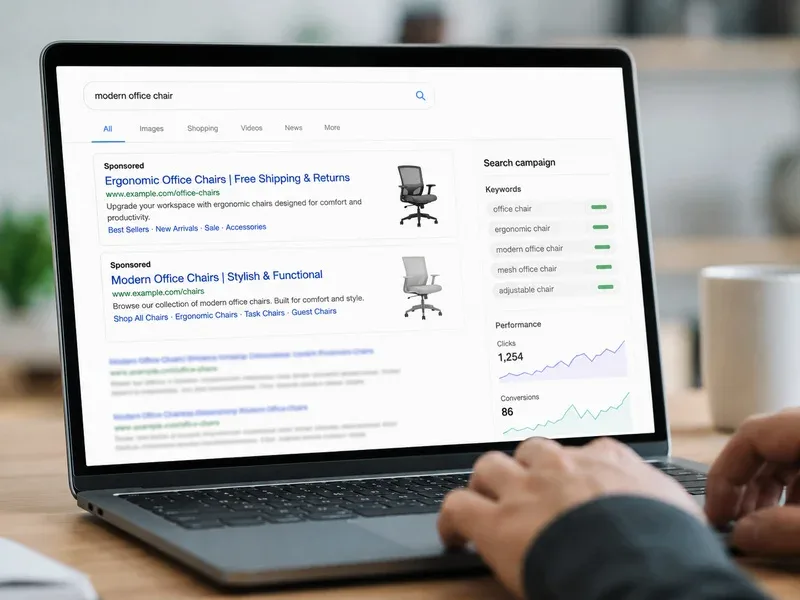
    Marketing analyst reviewing paid search performance dashboards on a laptop
    $8
    average return reported per $1 of ad spend
    Google
    Campaign Types — Function by Function

    Every Google Ads Format, Honestly Evaluated

    Select a campaign type below to see what it does well and what a healthcare practice should weigh before investing budget in it.

    Strengths
    • Reaches patients at the moment of intent
    • Highest conversion intent of any format
    • Text-based and fast to launch
    • Pay only when someone clicks
    Considerations for Practices
    • Competitive keywords can be costly
    • Requires negative keywords to avoid waste
    • Needs compliant, accurate ad copy
    • Landing page quality determines ROI

    Key Pattern: Search and local-intent formats drive the highest-quality patient inquiries; Display, Video, and Shopping play supporting or awareness roles. Match the format to the goal, not the hype.

    The Balance

    Paid Search and SEO Are Partners — Not Either/Or

    The smartest practices don't pit Google Ads against organic search. They weight both, because each covers what the other can't.

    Google Ads Strengths
    Immediate Visibility
    Live within hours of approval
    Precise Targeting
    By location, time, and audience
    Predictable Volume
    Turn budget up or down on demand
    Full Measurability
    Track every click to a booking
    Organic / SEO Strengths
    Compounding Value
    Keeps working after spend stops
    Patient Trust
    Organic results signal authority
    Lower Long-Term Cost
    No per-click charge to appear
    AI-Search Citations
    Authority that AI engines reference

    The strongest patient-acquisition results come from paid search and SEO working in balance.

    DIY Google Ads — The Honest Trade-Off

    A Self-Managed Account — What You Get
    A live campaign you can launch in an afternoon
    Basic keyword targeting and a daily budget cap
    Auto-generated responsive ad suggestions
    Standard Google conversion tracking tags
    Self-serve performance dashboards inside the platform
    For a single, simple service and a modest budget, a do-it-yourself account can be a reasonable way to test demand before investing in full management.
    What's Missing — The Critical Gaps
    FTC-aware, compliant ad copy that avoids unsubstantiated health claims
    HIPAA-aware landing pages with safe handling of patient inquiries
    Disciplined negative-keyword management to stop wasted spend
    Conversion-optimized landing pages built for appointment booking
    Smart bid strategy tuned to cost-per-patient, not cost-per-click
    Call tracking and lead-quality review beyond raw click counts
    AEO and GEO content so your practice is also found in AI search

    The gap between a self-run account and a professionally managed campaign is not cosmetic. It shows up directly in how much of your budget converts into booked patients — and whether your ads survive Google's healthcare policy and FTC review.

    Vigorant Website Design & CRO →
    Risk Assessment

    The 4 Biggest Risks of Running Google Ads Without Expertise

    Each of these risks requires specific human oversight to prevent. They are not hypothetical — they are the most common ways healthcare ad budgets are lost.

    HIGH IMPACT
    Budget Drain From Loose Targeting
    Broad-match keywords without negative-keyword discipline spend on irrelevant searches — job seekers, students, or unrelated symptoms — quietly burning budget that should reach real prospective patients.
    HIGHEST RISK
    Compliance & Claim Violations
    Google's healthcare ad policy and FTC rules prohibit unsubstantiated outcome claims. Ads promising to 'cure' or 'permanently eliminate' a condition risk disapproval, account issues, and regulatory exposure.
    MODERATE RISK
    Weak Landing Pages Kill Conversion
    Sending clicks to a slow, generic, or unclear page wastes every dollar spent to earn that click. Without conversion-optimized landing pages, even well-targeted ads produce few booked appointments.
    COMMON RISK
    No Conversion Tracking, No Insight
    Running ads without tracking calls and form fills means optimizing blind. You see clicks but not patients, making it impossible to know which keywords actually fill the schedule or what to cut.
    Marketing team reviewing campaign analytics and budget reports on screen
    The Answer

    The Model That Actually Works: Automation Inside a Human-Led Strategy

    The practices getting the strongest return on Google Ads in 2026 let the platform's automation handle volume — while experienced specialists set the strategy, guardrails, and compliance.

    Google Ads Automation Handles
    Real-time bid adjustments toward conversion-likely clicks
    Testing responsive ad combinations across thousands of impressions
    Audience and device signal processing at machine scale
    Budget pacing across the day and week within set limits
    Performance reporting and anomaly flagging in live dashboards
    Specialists Handle
    Campaign strategy, keyword selection, and competitive positioning
    FTC-aware, clinically accurate ad copy review before launch
    Negative-keyword and audience-exclusion discipline that protects budget
    Conversion-optimized, HIPAA-aware landing pages that turn clicks into bookings
    Pairing paid search with SEO and AEO so visibility compounds over time

    "Search advertising works because it connects you with people at the precise moment they are looking for what you offer — but the budget you keep is the budget you manage with intent."

    — Vigorant Healthcare Marketing Team
    AI chat interface showing a patient asking for a healthcare provider recommendation
    Patients are asking:
    "Who is the best orthodontist near me for adult braces?"
    Asked on ChatGPT & Gemini daily
    GEO & AIO

    Paid Search Today, AI-Search Visibility Tomorrow

    Google Ads captures the patients searching right now — but how patients search is changing fast. A growing share of provider research begins not on a results page, but inside an AI assistant.

    Patients increasingly ask ChatGPT, Google Gemini, Perplexity, Microsoft Copilot, and Claude to recommend a provider before they ever click an ad. Paid search and AI-search visibility are not competing channels; they are two halves of a complete demand strategy — one captures active intent, the other earns the recommendation.

    FAQ content structured to directly answer the questions patients ask AI assistants about your services
    Schema.org markup identifying your practice as a MedicalBusiness or Physician entity
    Named clinical authors with verifiable credentials cited on procedure and service pages
    External citations from peer-reviewed or institutional health sources
    Topical authority from a consistent library of expert-level healthcare content the AI engines can cite
    Explore Our SEO & AEO Services
    VERDICTVigorant · June 2026

    Google Ads is one of the fastest ways to reach patients — but only as fast as your strategy lets it be.

    Hours
    to go live with a campaign
    vs. months for SEO
    $8
    average return per $1 spent
    reported by Google
    100%
    of healthcare ads should be compliance-reviewed
    FTC + Google policy
    01

    Google Ads is the right tool when you need immediate, measurable visibility — launching a service line, filling appointment gaps, or competing for high-intent procedures.

    02

    For dental, medical, and chiropractic practices, the stakes are higher than for general retail. Your ads run in a regulated space where claim accuracy, HIPAA-aware data handling, and compliant copy are requirements, not options.

    03

    Vigorant is a healthcare-exclusive growth marketing agency. We run paid search inside a human-led strategy — pairing it with conversion-ready websites and SEO so your budget produces booked patients, not just clicks.

    FAQ

    Frequently Asked Questions

    Clear, evidence-based answers for dental, medical, and chiropractic practice owners on Google Ads, paid search, and how it fits a complete strategy.

    Google Ads, formerly Google AdWords, is Google's online advertising platform. You bid on keywords and pay — usually per click — to show your ads on Google Search, Maps, YouTube, and partner sites. When someone searches for a service you offer, your ad can appear above or alongside the organic results, letting you reach patients at the moment they are actively looking for care.